Friday, July 14, 2017

Portobello Road W10 by Chris Sullivan.

     Portobello Road; W10
by
Chris Sullivan ©2017

It was nineteen-ninety – a new millennium, we called it, although the millennium proper with all its problems and terror was ten years away.
I was standing on the corner of Portobello Road and Cambridge Gardens, looking for my pal, my old buddie Barry. It was seven-thirty in the morning and I should have met him at six. I knew he'd still be around, somewhere, as we had come to search for bargains. We were going to be high end antique dealers and millionaires. Barry had been watching The Antiques Road Show on television, he had a Miller's Collectibles book and I was a subscriber to The Antiques Trade Gazette and Exchange & Mart; so we were ready to go.
Portobello Road was and is quite an atmospheric location to hang out on Friday mornings, so I didn't mind too much as there was plenty to see: up the street I could see the junk dealers and gypsies loading their stalls; someone had brought their merchandise and rubbish on a horse and cart and as the cart was being unloaded the horse stood there depositing garden fertilizer on to the road surface, which used to be called the horse road in years gone by.
One solitary horse in a street; a street which was part of a city which, a hundred years before, would have housed, or stabled, two hundred and fifty thousand of them. Each week, hundreds or so dead horses would be taken from London to be disposed of, together with many millions of tons of horse manure for agriculture.
In some parts of the world, and not too long ago in London, people would run out from their dwellings and collect the dung with a spade and fill buckets as the manure was great for their gardens. This time it just lay there, steaming.
It is supposed to be good for agriculture because horses don't fully digest their food if it isn't grass; bits of undigested oats in their excrement feed the sparrows too but these days there are very few horses about and consequently very few sparrows.
Somewhere in the melee of dealers and boxes was Barry and as I looked for him at the junk end of the street I knew that behind me, under the canopies and stalls with covers, was the posh end.
Jim had told me that on the posh side many many thousands of pounds would change hands before dawn every Friday; Friday was the trade day and Saturday was for the tourists and public.
Jim was a gypsy from Ireland; he cleaned out jumble sales and car boot sales and brought everything to Portobello Market, and whatever was left at the end of the day he would donate to the local tip where other dealers would buy the stuff from the people in charge.
He seemed to do okay spending most of his holidays touring the continent in his tiny caravan with his wife and large family. As I looked around for Barry I could see Jim standing on the other side of the street, behind his stall, smoking a cigarette and sitting on a pile of cardboard boxes.
'Hi Jim' I said as I walked to his stall.
'Did you do any good?'
'I've just arrived' I said 'have you seen Barry?'
'I told you to get here for six if you want to stand a chance' he said sarcastically, puffing on his fag.
'I overslept' I said.
It seemed a bit of a strange thing to say, at that time of the morning, - I had been up since dawn! How can that be oversleeping?
I had dashed out of the house, driven like a maniac down the A40, luckily found a parking spot in Ladbroke Grove and walked along Cambridge Gardens to the spot I said where I would meet Barry all before seven thirty; very unusual for me!
'Have you seen him?' I asked again.
'I just arrived myself' he said, as he took out another fag and lit it on his old one: 'I'll unpack as soon as I've had my smoke.'
'Think it'll be a good day, today?' I said.
'These days people don't want to spend any money.' he said.
I left him complaining and moaning and going on about back in the day and how things used to be when you could buy a twopenny cigarette and a cup of tea for less than a quid.
We came here at Jim's suggestion – we? - where was Barry? But it doesn't matter where you go nothing is the same – and why would it be?
In my day people had rickets!!
The pair of us, me and Barry, and even Barry and me, were novice antique dealers. He knew a lot more than I did and I was learning as we went along. I had a few bob in my pocket, from being made redundant, and I wanted to make money with it as opposed to pissing it up the wall or losing it at the bookies; if we saw something cheap, that we could sell at a profit, we'd buy it.
We went to antique fairs, car boot sales and auctions: learning all the time, buying a bit here and a bit there. Antique Fairs were funny; little old ladies hiding behind a great pile of porcelain doing their knitting; they didn't seem to be in business at all. It was as if they'd taken the contents from their front room to display at the local church hall or hotel. If anybody asked how much something was, the stall holder would come out from her knitting, stand in front of the table, and give a full history of whatever was for sale.
All the customer wanted to know was the price!
I think the only good thing about those kind of fairs with the ridiculously high prices was that some of the prices are sometimes ridiculously low!
Barry bought a piece of Clarice Cliff one day from a 'know all' dealer for ten pounds and sold it to another for a hundred.
There was a little bit of an alley way near Jim's stall which led to another road where there is sometimes a parking space where Barry would park if it was available. All I had to do was to look for the blue Volvo with a load of smoke coming from it and I would inevitably find Barry. It didn't take long; there was no smoke, as he wasn't smoking, but I saw the silly roof rack first.
Barry had gone in to debt for the car and it looked quite smart – apart from the roof rack which was about twenty years older than the car and made it look quite scruffy – a nice blue Volvo and a scruffy roof rack!
He was sitting in the front seat, reading a newspaper and scoffing a bag of chips. That was the nice thing about the neighbourhood on market days; you could buy chips from dawn.
I knocked on the window and he pressed the button and it opened 'where you been?' he asked.
'Overslept!'
'Silly bugger.'
I thought he was going to continue reading his newspaper when I saw him turn away but he was reaching for something under the seat.
'What's that?' he said, holding up a candlestick.
'A candlestick?'
'I reckon that's Sheffield Plate' he said, stuffing it back under the seat.
I knew that Sheffield Plate was a fusion of copper and silver plate – something like that – as I'd looked it up in Barry's book but I'd never seen it before.
He told me that he'd spent all his money and hoped for about three hundred profit – if he could sell it all.
He got out and we walked off 'I'm going for a cuppa – do you want one?' he said.
I nodded and told him I was going to give it a try no matter how late I was and left him.
As I walked back to Portobello I saw an attractive young red headed girl talking to Jim as he was putting his goods out on the stall.
As I approached, Jim said 'watch this fella - he'll bite your hand off for a bargain.'
'Take no notice of Jumble Jim, love' I said 'when he's not here he's at his villa in Spain.'
'I wouldn't mine being in a villa anywhere today' she said as she rubbed her hands together.
Jim took some kind of scroll out from one of his boxes; I picked it up and opened it slightly and I could see Hebrew writing – The Dead Sea Scrolls? I thought.
'How much?' I asked.
'Fifty' said Jim.
I put it down.
'How much did you say?' said the girl.
'Fifty' said Jim 'fifty pence.'
'You're on' said the girl giving him a fifty pence coin and walking off with the scroll.
I stood there with my mouth open. Fifty bloody pence and I thought he meant fifty pounds.
'See you Jim' I said and walked after her.
She went behind one of the stalls at the posh end then Barry stopped me and bunged a cup of tea in to my hand.
'Who's that girl?' I said
'What girl?'
'That red head there. Going behind the stall' I said between gritted teeth.
'Don't know – must be casual' he said, adding 'why do you fancy her?'
'She's just bought a Jewish scroll from Jim. Go and find out how much it is' I said as I took Barry's tea from him before walking over the street and ducking behind a car.
I watched Barry talking to her; I didn't really want her to know I was still interested. They chatted and he came back.
'How much?'
'Hundred and fifty pounds' he said.
'How much?' I repeated.
'One hundred and fifty pounds.'
'You're joking.'
'I'm not' he said 'it's cheap; must be worth about six hundred.'
'Are you sure?'
'Maybe more' he said 'and I'm skint.'
'If you're sure we'll buy it between us – fifty fifty.'
I gave my cup of tea to Barry and walked towards . . . towards the scroll.
'Hello again' I said to her 'guess what I'm after?'
She lit up a cigarette and shrugged.
'I'll give you a profit on the scroll.'
'Sounds fair' she said and she kind of batted her eye lids at me as she took a huge pull from her fag.
'How does a fiver sound?' I said.
'Sounds terrible' was her reply - 'I told your pal the price when you were hiding behind that car.'
'You saw me?'
'I saw you.'
I took three fifty pound notes from my back pocket.
'Is that your best?' I said as I picked up the scroll and handed over the money.
'You want me to knock something off?'
I nodded.
'How does a fiver sound?' she said.
'Terrible.' I said and I took the fiver.
Just along Cambridge Gardens is a tiny park; Portobello Green. It seemed to attract drunks and the down and outs from the neighbourhood; I thought the best thing to do was to go in there, sit on a bench and look at it.
'Where you going?' said Barry as I swept past him.
'To look at it.'
'What about your tea?' he said as he trotted up to me.
'Come on' I said and we went into the park.
The place was full of drunks, as usual, with the signs of drug taking and condoms by the only vacant bench. Barry came running up behind me intent on making me drink the dreaded tea.
'Don't run, Nick' he said 'they'll think we pinched it.'
I wasn't running just walking fast; I couldn't wait to have a look. I approached a man who had either fallen or taken a severe beating. The right hand side of his face was covered in cuts and his forehead had a large newly formed abrasion; he muttered something as he staggered past.
'You okay, mate?' I said.
'Do you have fifty pee?'
I gave him a pound coin and sat on the bench. Barry sat beside me and put the tea into my hand as I handed the scroll to him.
He looked at the outside, turned it around to see if it was straight or not then, very carefully, unrolled it and looked at the Hebrew writing. His face was filled with wonder and appreciation.
'It's worth a lot more than I thought' he said, looking at me; I could see a tear in the corner of his eyes, 'it's worth millions and millions; as much as you can imagine.'
'That much?' I said.
'That's what it's worth' he said 'but you want the price.'
I nodded.
'Bring this to me at Covent Garden on Monday and I reckon Invernezzi will give me a couple of grand for it; maybe more.'
'Take it with you.' I said.
'No no – it's yours – I haven't parted with any money yet.'
'I said fifty-fifty; I wouldn't have known how much it was worth; I never saw one before.'
He looked at me with that look he always gave when I've said something silly 'I've told you before' he said 'anything Jewish is always worth buying.'
He handed the scroll back to me very carefully, as if it was thousands of years old; it might have been, for all I knew.
A man came into the park; he was walking very slowly and it was obvious that he was coming towards us. He wore a white trench coat and a black trilby hat and as he walked he was rubbing his jaw as if it helped him ruminate. His body movement together with his appearance reminded me of a Jewish Humphrey Bogart. I looked at him and a half smile lit up his face.
'Who's this?' I whispered to Barry.
'Good morning' the man said in a crisp and clear New York Brooklyn accent 'I'm interested in what you got there.'
We looked at him.
'Do you mind if I take a look?'
'Take a look?' said Barry.
I looked at the man; was the scroll hot? Was he the police?
'I saw you purchase it at the market there – I missed it by a whisker.'
'Sit down' I said.
He did; between us. I gave him the scroll. He took it and, looked at it very closely. 'No cover?' he said, looking at me.
I looked at Barry 'cover?' I shrugged.
Barry looked at the man 'no' he said.
'Naked as a baby' said the man, almost to himself.
He seemed to know a lot about it and understood the Hebrew, smiling slightly as he read it.
'Is this for sale?' he said.
'It will be' I said.
Barry didn't look too pleased.
The man continued to look at it then looked at Barry and said 'how much?'
Barry looked at me 'Nick?'
'A thousand' I said.
Without missing a beat the man said 'dollars or pounds?'
I gulped 'pounds!'
He smiled to himself 'I guessed as much.'
He looked back at the scroll; Barry looked at me and I winked; I knew this fella was interested.
'How does a thousand dollars sound?' he said.
'How much is that in pounds?' said Barry.
'About six hundred' said the man.
Sounded fair enough to me; I put my hand out to shake on the deal but he put the scroll into it 'what about a thousand dollars and fifty pounds cash?'
He really wants it, I thought, as I nursed the scroll in my lap. In the distance I could see the man, to whom I had given the pound coin, settling down for a rest behind one of the benches.
I'll hold out for more money, I thought; I turned to look at Barry whose face was a picture; I remembered he said he would get a couple of grand from Invernezzi at Covent Garden.
'Sorry I can't do it' I said, I was really playing the big dealer now; Barry looked a bit shocked, 'I'll get two grand at the garden.'
'The garden?' he said suddenly, obviously thinking of Madison Square Garden in New York.
'Covent Garden' said Barry.
'On Monday' I said.
He took his hat off, revealing his bald head, and started fanning himself with it; then he put it back on.
'Gentlemen' he said 'I really didn't come out to spend that kind of money.'
He looked at us; we didn't respond but the three of us looked ahead. The man who had settled down for a sleep was getting up and started walking towards the park gate.
'My name is Green' our man said 'Martin Green; if I can meet you tomorrow I'll give you . . .' he paused for a moment; as he did he looked at us, his bright brown eyes darting from one of us to the other; he took a deep breath 'two thousand dollars and three hundred English pounds.'
'That's about nine hundred pounds' said Barry.
'No it's not' I said 'It's . . .about . .'
'Fifteen hundred' said Martin Green 'Pounds.'
'It'll still give you some profit' I said.
He looked straight into my eyes. 'This is not for profit; this belongs in the place of prayer.'
Barry laughed: 'we thought you were a dealer.'
'Gentlemen' said Martin Green 'I'm flying home tomorrow night and I'd like to take this with me; can we do a deal?'
I said 'If you'll excuse us for a moment I'll let you know.'
'Excuse me' he said.
'We need to discuss it.'
'Oh oh' he said, and jumped up from the bench.
'Sure sure' he said and walked off around the park.
When he was out of ear shot I said to Barry 'what do you think?'
As usual he threw the ball back into my court 'It's not up to me it's yours.'
'Fifty-fifty' I said.
'In that case it sounds okay. I would have been happy with his first offer.'
Martin Green was still walking and the way he was heading would bring him back around to us; so I waited for him to get closer.
'Okay' I said 'it's a deal.'
It seemed to release a big weight from his mind and his face lit up into a big smile.
'Great' he said 'I'll meet you here tomorrow – same time?'
I looked at my watch; eight-o-clock.
'Do you have a card?' he said 'in case I need to reach you?'
A card? I didn't even have a piece of paper. I threw the remnants of my tea away and tore a small piece of polystyrene from the cup and wrote my number on it.
'Here' I said 'that's my home number but I won't be there till later this afternoon.'
'But we'll be in the Latimer Arms between eleven and twelve' chipped in Barry.
Martin Green wrote Latimer Arms on the piece of polystyrene I'd given him. He smiled and put it into his pocket. I gave him my hand to shake 'Nick Murphy' I said 'good doing business with you.'
'Likewise' he said and walked off out through the park and into Cambridge Gardens. We watched him walk away.
If this was Portobello Road we would certainly come again.

It was four-o-clock in the morning in New York City and Frank was fast asleep in his apartment. The phone rang, next to his bed and he woke up with a jolt. He could see his clock illuminating the time at him; four-o-clock in the morning was not a good time for Frank. It was four-o-clock in the morning three years earlier when he got the call to go to the hospital. His beloved wife Rachel had died but the hospital didn't tell him that. They spared him the shock and just told him to come in as she had taken a turn for the worse. When he got there they told him. Frank picked up the phone; it was Martin – Martin Green.
'Hi Frank' he said 'did I wake you?'
'No Marty' said Frank 'I just got out of the shower.'
He swung his legs to the side of the bed; it felt good doing that as he could do little else so sprightly at his time of life; he reached for his spectacles to await the bad news then he realised: Martin was in London.
'Good' said Martin 'I'm badly in need of some rabbinical advice.'
There was a glass of water, Frank always kept, on what he called the nightstand, which he reached for to let Martin give him the news about Portobello Market. He let the water freshen his mouth as he listened, intently.
'You want us to give it a home, right?' he said to Martin.
'Right' said Martin.
'You betcha.'
Frank would give various talks about amusing aspects and histories of Jewish Law, and one time spoke about a huge stockpile of scrolls found in Czechoslovakia after the war. The Nazis final solution to exterminate the Jews also included the establishment of a Jewish museum to celebrate the extinction of the Jews; the scrolls were going to be a part of that. It was said that they were sent to Britain, and were then sent to various synagogues, throughout the British Isles, who were charged the princely sum of £100 each. Martin had remembered that Frank referred to the museum as a weird Nazi Museum.
'I'm glad you have it' said Frank 'I wouldn't like to see a Sefer-Torah going to some screwball collector to hang on his wall.'
'Well' said Martin 'I offered the guy my last two thousand bucks, which I will give him tomorrow when we . .'
Frank interrupted 'You mean you don't have it yet?'
'No I gotta meet him tomorrow – he might even try for more money . .'
'I'd be surprised if he doesn't.'
'Why? How much is it worth?'
'Work it out for yourself' said Frank 'hand written on parchment, a year of someone's life: and how old it is.'
Martin gulped audibly down the phone.
'If we were to go out today, Marty, to buy a Sefer-Torah we would have to pay at least ten thousand dollars.'
'Ten. . .' Martin stammered 'you're kidding.'
'Get on to the guy right away, Marty, right away, before someone else comes in with a better offer. Pay him the full price and I'll wire you the difference.'

I looked at the scroll, which I had cradled in my arm, as Barry was at the bar getting my Guinness. What cover did Mister Green mean? I supposed it would be some kind of velvet thing; Barry had said he saw a picture of a scroll when he attended night school for antiques. I hadn't bothered to go but Barry said he enjoyed it and got a lot out of it. He came back with the drinks.
'Not a bad day's work today' he said.
'Here's to plenty more' I said, clinking the glasses.
'I thought you blew it back there for a minute' he said.
'When?'
'When you said you couldn't do it.
'I knew he wanted it' I said 'cover or no cover.'
The barman shouted over 'Is there a Nick Murphy here?'
'Yes' I said.
'Phone call' the barman said and put the phone on the counter.
There was only one person who knew where I was and that was Martin Green.
'Mister Murphy – Nick' came the unmistakable Brooklyn accent down the line.
'Yes.'
'Martin Green; remember me?'
'Of course I do.'
'I really want that . . that item I saw today.'
'I know you do' I said, looking at the scroll in my hand.
'I've just been on to New York and I am authorized to offer you eight thousand dollars.'
Eight thousand dollars! What was the matter with the man? We had already made a deal. What could I say?
'How much is that in pounds?'
'About five grand, I guess' he said.
'Sounds great' I said and it did. I couldn't believe it.
'Do we have a deal?' he said.
'We do.'
We did indeed.
'It's gonna take me a little time to get the cash together with transfers and so forth and I'd like to meet tonight?'
A thought, a profound thought had entered my head, so I told him we should keep to the time in the morning as I was busy that night.
Barry was standing next to me; he couldn't hear any of the conversation but he knew it was good news and I could see by his eyes he was excited.
'Don't tell me' he said 'he doesn't want it?'
Barry is as dry as they come but he looked at me eagerly for the price.
'You'll never guess how much he's offered' I said.
He looked at me in anticipation.
'Five grand' I said 'straight in, no haggling, five thousand pounds.'
Without a smile, a twinkle in the eye or anything else Barry said 'it must be worth more than I thought.'
Damn right it was; that was the thought I had when I was talking to Mister Green on the phone; how much more?
'Call Invernezzi now' I said 'see how much he'll pay.'
'What about Mister Green?' he said.
'If Invernezzi pays more forget Mister Green.'
'Play one off against the other' said Barry. I nodded 'I like it' he said, with the same straight face.
The telephone was still on the bar and I could see Barry asking permission, then taking out his address book and dialling. I sat back and took a sip from my pint as he returned.
'No answer – he must be out buying' he said.
'Okay' I said 'call him when you get home and tell me about it tonight.'
'Tonight? What's happening tonight?'
'We'll take the girls out to celebrate' I said 'I'll pay.'
'I like it even more' he said as we clinked the glasses together again.

Getting up at dawn and ending with a quick pint in the pub always affected me the same way; I wanted a nap. So that was what I planned the minute I walked through our front door.
I opened the door and there was silence; nobody in. I was glad in a way as it meant I could go straight to bed without having a chat with Helen. I dropped the scroll onto a suit-case in the hall and called upstairs in case she was in; no reply. On the table, in the kitchen, was Helen's cassette recorder with a card on top which read Play me! I pressed 'play' and sat back in anticipation:
'Hello my darling' she said 'I've gone to Judy's for the afternoon and I'll be back at about five; byeee.'
Then she made herself laugh and switched off.
I had to have a go as well so I turned the card over, wrote play it again Sam on it, recorded my message and went to bed.
I slept like a log and didn't hear Helen come in; she saw my note and played my message telling her that I had had a great day and to wake me at about seven as we were meeting Barry and Sue for dinner.
Whilst she was listening to my message there was a ring on the door bell; she broke off to see who it was and standing on the doorstep was a little boy 'jumble?' he said.
'This lot here' said Helen and went back to the recorder.
The little boy, a boy scout, picked up the suitcase, with the scroll on the top of it, and went out; 'bye' he shouted and that was that.
When I came down the stairs the first thing I noticed was the vacant space by the last step where the suitcase had been – together with the scroll.
'Helen' I called.
She came out of the sitting room 'where's the case that was here – with a scroll on top of it?'
'The boy scouts have it for their jumble sale; just some old . . .'
I ran to the front door, wearing only my towel robe 'where is he?'
'He was here a couple of hours ago – the sale is tonight.'
'Come on let's go' I said, and I picked up the car keys from the hook and ran to the car.
I didn't know where the sale was supposed to be and neither did Helen. There were a few places we could try, which we did, but by the time we got to the last sale it was around eight-o-clock and that one had finished.
Helen looked at me 'sorry' she said but it wasn't her fault and I told her. She wept a bit when I told I had spent a hundred and forty five pounds and when I told her the full story she was really sorry but instead of bursting into tears she started laughing. I was wearing nothing but a towel robe and we both had a laughing fit for some time; it was my fault for being greedy.
The worst part of the whole affair is that there was a man called Martin Green who really wanted the scroll and now he wasn't going to get it.

The next day I met Barry at Portobello Road as planned; he hadn't 'laid out' any money but he called me a few choice words. We went along Cambridge Gardens to where we could see in to the park and the spot where I was to meet Martin Green. He was there, already, sitting on the same bench, wearing the same black trilby and the Humphrey Bogart trench coat. He sat there; occasionally looking about with a look of half knowing that I wasn't going to show, one minute, and a look of anticipation the next.
It took me a long time to make up my mind that I wouldn't make an appearance. It might sound like cowardice, and maybe it was, but as soon as he would see me coming his expectations would lift and he would expect me to have the goods.
Barry went off to the greasy spoon café just around the corner to order our breakfasts and I said I would meet him in there.
After a few minutes, and maybe twenty minutes after I had arranged to meet him, Martin Green got up from the bench and started to walk towards the gate; he would be mulling over what to say to his pal in New York. Frank would probably meet him at the airport and tell him he had found a place on the wall just outside the portal of the shul to show a sefer-torah which had been stolen by the Nazis and rescued by Martin.
I walked along Cambridge Gardens as I didn't want him to see me and hid amongst the second hand clothes on one of the stalls. He stopped on the corner of Portobello Road, the place where I had waited for Barry twenty four hours earlier; was it really only twenty four hours?
He stood there for a few minutes, not too far from the greasy spoon café where Barry was; I prayed that he wouldn't come out. But Martin was looking for me. Opposite Martin I could see Jim – Jumble Jim, setting out his stall and puffing away at a cigarette. He wasn't greedy – not like me – he would buy stuff for very little and sell it for a bit more and that's how he managed to travel each year.
Martin took off his hat and fanned it in front of his face and I moved along the second hand clothes rack to where I could see both Martin with Jim in the background.
Martin put his hat back on and wandered over the street to Jim. They chatted for a while and as they talked I could see Jim take the scroll out of a cardboard box the way he had done the day before– at least I was sure it was the scroll. Martin looked at it; he didn't move; didn't say a word. Again he took his hat off; he didn't fan himself but stood there motionless with the hat in his right hand.
'How much?' he said.
'Fifty' said Jim.
Martin picked up the scroll and cradled it gently in his arms as I had - like a baby. He had five thousand pounds in his pocket for me and no loose change. Should he give this man five thousand pounds? Would that be the moral thing to do? He looked at Jim: a gypsy, he thought, the Nazis took these scrolls from us, exterminated both my people and his and now God is getting it back to me through a gypsy.
That's what Martin was thinking as he reached into the top pocket of his jacket, underneath the trench coat, where he kept some fifty pound notes. He took one out and handed it to Jim.
'Fifty' he said.
Jim said 'I have no change. . .'
But Martin held his hand up to quieten Jim who put the fifty pound note into his pocket.
'Thank you, sir' he said 'thanks very much.'
I wasn't sure at this stage what Martin had bought; it looked like the scroll but I still wasn't sure, then I realised that Jim cleared Jumble sales; Jumble Jim. Of course. Nobody had bought it, it had remained on the counter for the whole sale and when they were clearing up Jim came, made them a job offer and took everything off their hands.
Martin Green turned around, crossed back over Portobello Road and walked towards me. It was too late for me to hide so I carried on walking. Martin wasn't looking at me, he was in a world of his own; everything had fallen into place after his day of trying to get the money wired over from New York and then finding a bank where he could transfer it into cash, and I was happy for him; I really was. To hell with the money.
As he got closer he caught my eye and as he passed he lifted his hat. I could see the end of the scroll under his trench coat and when we crossed he winked at me; 'I got it' he said and he was gone.
THE END.

I wrote a screenplay for my film The Scroll around 1989 or so and not long before I went to America in 1994 I adapted this short story from the script. I found it the other day and wrote this draft; let me know what you think.


Thursday, June 29, 2017

A CHANGE OF CLIMATE.

The title of this piece is the title of the novel by Hilary Mantel; a very clever novelist who writes historical fiction; I write hysterical fiction but not on purpose.
Hilary Mantel gave The Reith Lectures this year which are currently being broadcast. The Reith Lectures are commissioned by the BBC and are broadcast on Radio 4 – the serious radio station which the BBC broadcast, as they are a broadcasting company even though the 'C' doesn't stand for company in this case but corporation. Originally it did stand for the former, when it was formed or created in the early twentieth century, but not so early in that century as you might imagine. In other words 'I ain't looking it up today.'
When I first became an actor, which happened to me one day as I was walking along a back street in Birmingham I saw a television star, aha I said to myself; an actor! I am an actor too. In those days I probably said acter; the 'or' came later when I'd been introduced to John Gielgud – not personally, you understand, as I'd never heard of him before that point. In fact I might have been one of those smart arsed herberts who would, on being told that man was an actor, go up to him just to tell him I'd never heard of him. A lot of people think that's very clever as people have said it to me and at the time I wished them no malice but would wonder why I was getting such a comment; but I jest: I would never have gone up to anybody and showed them my ignorance and neither would I now. When I was told that there was a great actOr called John Geilgud, I would pretend I knew who he was and then . . . . I would have to scurry off and find things about the great man – with no google in those days.
Anyway the point of all that was that when I joined Equity they gave me the rule book (they did in those days – doze daze) and when it came to the BBC they referred to it as the mighty corporation as even though they paid and obeyed all the union rules they would never recognise us.
Back to Hilary Mantel who wrote other books: apart from the title of this piece, namely Wolf Hall and Bring up the Bodies; I have to add too that she also wrote The Assassination of Margaret Thatcher.
I haven't listened to every lecture, which are usually given each year by prominent people who know what they're talking about; Kwame Anthony Appiah gave them in 2016 and the year before it was Professor Stephen Hawking. 

So you see they are no slouches.
When asked a question from the audience about Brexit, Hilary Mantel said “There has been a gigantic failure on the part of the voting public in Britain to know their history, to examine the evidence that was put before them, and a giant failure of imagination. I think the whole thing is shameful, regrettable and I think time will prove how destructive it may be. All nations have a fantasy of a golden age, but I would say ours was to come. I'm not so sure, now.”
Now that says something about the subject doesn't it; precise and to the point.
People have different opinions about Brexit apart from discussing how it's pronounced – this is Britain what else would they talk about? Bregsit or Brexit – the fact is most people use the former but because it is Britain someone will get in touch and say it's the latter.
I don't fall out with people because they have a different opinion from me it is up to them what they think and the truth of the matter is we will not really know for a long time whether Brexit is a good or a bad thing for Britain.
Someone said to me on the bus today 'the whole country is going down the drain.'
I said 'going?'
The fact is most towns or villages had a post office. They were more or less the same kind of buildings; you could see the post office when you went to a strange town – a strange town to you, that is, not some strange place – so you could at least find it. In the last few years those post offices have been closed and moved to some other store like the rear of W.H. Smiths and . .. well W.H. Smiths. A newspaper shop/stand come stationers – now post office. 
There they are at the back of their stores with the post office staff agreeing with every customer who says it was better back in the day when the post office had proper post offices. If they ever tried to close the post office in Dublin – the GPO – there would be trouble!
But it doesn't matter where you look there is always some kind of change going on. At the moment there is a movement to close down pharmacies – they're called chemists here. Now why would they want to do that and how could they?
This country has a welfare state; all medical facilities are free at source and managed by the NHS; The National Health Service. All the people rescued from the fire two weeks ago will be cared for nursed and operated on free of charge in the hospitals. Any cost will be met by the government. Medicine including prescriptions are "nominally" charged for and lots of the times they are free. The pharmacies process the prescriptions and even deliver to the patients if needs be; there is a move to limit the number of pharmacies in each neighbourhood.
What does this mean?
The NHS rely on these pharmacies; without them the NHS wouldn't work. Without the NHS the pharmacies would go out of business. There are a few pharmacies in Pinner, were I live, and if they close all except one which one would it be which will remain open and make a lot of money? 

One chemist means there will be lines going around the block to pick up prescriptions; half the time the medication will not be in stock it will be at another branch so will be delivered the next day. The chemist will be Boots Chemist - doncha wish you have bought stocks in Boots and W.H. Smiths when you had the chance; still not too late.
There is no way the government will actually close the pharmacies, they will just cross them off the list of pharmacies licensed to fill NHS prescriptions – easy.
Just reminds me, somehow, of the Taliban bombing all those ancient statues of the Buddha about 25 years ago in Afghanistan.
Going down the drain – I should cocoa.
THIS SHOULD BE WRITTEN IN STONE
There has been a gigantic failure on the part of the voting public in Britain to know their history, to examine the evidence that was put before them, and a giant failure of imagination. I think the whole thing is shameful, regrettable and I think time will prove how destructive it may be. All nations have a fantasy of a golden age, but I would say ours was to come. I'm not so sure, now. (Hilary Mantel 2017).

Friday, June 16, 2017

A London Tragedy.

Today is June 16th which is Bloomsday; the day James Joyce set his novel Ulysses in 1904 as that is the first day he set out with the love of his life; Nora Barnacle. I usually write something about it but this post will only be set on June 14th and 15th of this year.
London is one of the greatest cities in the world; you may have another opinion but I love it; I always have. I have grown to like Los Angeles better, with New York and Dublin in my top few too. But London has been hurting these last few months.
The other place that was hurting, in Britain, is Manchester. I am sure one of my relations might have been in that theatre of young kids when a piece of snot, that had been wiped on a wall of a human being, blew himself up and killed many people which included lots of kids. The pity about life is the relations I have in Manchester have gone their separate ways with most of them extending the Irish diaspora and strayed to other parts of the world. I know some are in New York but many still live in Manchester.
In London here were two terrorists murderers on the loose in March and a couple of months ago then this week a fire burnt down a Tower Block in west London.
There it is above Grenfell Tower; that photo was taken sometime during the first few hours of June 14th – there have been many speculations by all the experts under the sun, telling all and sundry how it happened but you don't need to be an expert to know that if you wrap a building in a cladding that is not fire proof it will catch fire and spread to the rest of the building as opposed to remaining local on concrete.
Last night I buttered some toast, ready to put on some lemon curd and send it down the hatch with a hot drink and as I felt into the drawer for the fish knife, which I use as a butter knife, I thought of some individual who, 2 nights before, would be preparing a little snack for themselves, putting their utensil away and settling down to watch TV. 
That TV and everything else around them is no more. Gone up in an inferno and the person would be lucky to survive. They would be left with nothing – not even a change of underwear or maybe not even any footwear.
People look at them on their television sets and feel sympathy for them and their plight. See them desperately trying to tell the TV reporters what happened, trying to make a case and asking questions; questions questions questions and if they got any answers they would step back and realise there is nowhere to go. All their keepsakes and memorabilia gone; their books, magazines and treasures; all gone.
The big thing that was realised after 9/11 is that paper survived: pieces of paper blew over the streets of Manhattan for many months after the planes hit the World Trades Centre Building and sure enough, the other morning, pieces of paper with a child's page of homework was drifting around the streets of North Kensington. Of course it was on the news all day as the fire was not put out; even now the building is not considered safe.
I thought what it must be like so I threw some clothes in to my case and went down there – nothing much: a few pairs of jeans, shorts and some shirts.
The first thing I saw when I got off the tube train at Latimer Road is what you see at the foot of the page. One of the people being interviewed on TV said “people should not have to live like pigeons.”
Just look at it – at least pigeons can fly.
When I came out of Latimer Road tube station I was directed by a policewoman to the end of a street to donate what I had brought. On the way up the street I saw hundreds and hundreds of people, all volunteers; loading vans directing people with donations to various places.
Food was brought; really good food I heard. Not only the survivors but the volunteers needed to eat.
There were lots of toys, buggies and push chairs; cosmetics and sanitary stuffs, all were needed. Just think what you are doing now – whatever you are using, the survivors have lost. If they have a pen in their hand it will be something that was donated.
I went in to a club, which normally would be serving alcohol, and the floor was covered with donations. Then in to a yard at the back and loads of boxes were marked with shirts, men's hoodies, shirts etc. I found some boxes for what I had brought.
Going back outside I was reminded of 9/11; there was a plain wall where people had written messages in desperation in case someone had seen their loved ones. There were bunches of flowers at the bottom of the wall. 
I saw all this on TV when 9/11 happened and there it was in front of my eyes.
Grenfell Tower is in a very eclectic neighbourhood of London; maybe even Bohemiam rather like some areas of New York, San Francisco and LA, and consequently breeds a lot of great characters and is possibly a writer's delight and the people of the neighbourhood all came together that day; yesterday.
My visit there was emotional; people were crying and looking for lost relatives, others carried photographs and would ask if their sister or brother had been seen; maybe their parents and some were looking for their children; and all the time a buzz of activity could be heard.
It was also inspirational – but these people will want answers; will want to know why they were buttering toast one minute and the next not only homeless but helpless. Throwing their arms around their children who survived and not being able to say much without a tearful break in their voice.
You see it's okay to have sympathy but empathy is what was needed beforehand.
Here is a place where you can send some money; it will convert to your currency automatically so many thanks: https://secure.thebiggive.org.uk/donation/to/5144/27122/


Sunday, June 11, 2017

Bobby Smith

I am totally and utterly fascinated by something: you may have noticed that we had an election here in Britain last week; a general election. Well actually you might not have noticed. I know that there are people here who don't know that there is an election in France today and that is only 22 miles across the English channel. I always thought about that when I would go 22 miles out in the Pacific to Catalina, a little island, where we would eat sea food and go down deep in to the bowels of a boat with a glass bottom where we would see loads and loads of fish and plants and all the Jacques Coustaeu type of scenery.
But back to the election: each candidate, including the Prime Minister, have to get elected in their own constituency. They don't have to live in that constituency, like in America, but a lot of the MPs (members of Parliament) do own or rent property where they are standing and where they can hold regular surgeries – mainly on Saturday mornings.
The Prime Minister, Theresa May, stood in Maidenhead, which seems a very apt name under circumstances, which is a very rich place.
All MPs have to win in order to take their seats in The House of Commons where there are 650 seats. The winning party has to secure half of that, 625, plus 1 to have an overall majority. An overall majority is when all the parties, added together, cannot vote the government out of office if ever it came to a vote of 'No Confidence.'
You will wonder, if you looked, why this post is called Bobby Smith. I have to say that it is a famous name in sport in that he was a great centre forward and played for Tottenham Hotspur (the spurs) amongst other clubs.
But that is not the Bobby Smith in this piece; Theresa May had many people standing against her in Maidenhead, in fact there were 12, which brought the total up to 13 and Bobby Smith, a 35 year old heavy goods driver came last. He was an independent candidate standing for family court reform whatever that is and Give me back Elmo.
There he is at the top of the page – now what had astounded me is that he only received 3 votes. Out of an electorate of about 55,000 he got just 3 votes. Theresa May received 37,718 and had about 64% of the vote.
But what happened to Bobby Smith; how many friends and family did not vote for him? Let's look, he must have voted for himself – hang on he lives in Stevenage so he won't be able to vote in Maidenhead. Didn't he have any friends there?
When I have appeared in Edinburgh at various festivals I have often wondered, when I have asked at the box office, why there was nobody booked for a certain night – well I wonder no more; Bobby Smith, even though he was standing against the highest profile candidate in the land could not attract more than 3 votes.
Jacques Coustaeu type of scenery
Catalina underwater

Sunday, June 4, 2017

I enjoy doing this.

Hey: I enjoy doing this. I don't get paid much, only the income from the ads, but that doesn't amount to a hill of beans (to quote from one of my favourite movies) so I do it because, as I say, I enjoy it. I would write more often but have other things to do.
There are lots of things going on and experts coming out of the wall, meeting you in a pub or talking to you at bus stops – for those that use the bus. 
In London that's not many as at least 60% use the tube with another 20% or so using the overground which doesn't leave that many for the bus especially when about 10% drive, cycle and walk – BTW all from Time Out!
Listen to the 'so called' expert to your peril.
I have repeatedly said on this blog that I am an expert on nothing and that has never worried me but . . I know this: most bad things go away. All those bad things that you thought would never go, have gone. If you haven't forgotten them I'm sorry but living in America I thought George W Bush would never go – some people liked him – but he is all but forgotten now. He wasn't an expert at anything and, like Trump, he discovered that, even though he was the so called leader of the free world, he didn't have that much power.
A religious born again Christian going to war? Gimme a break!
There is trouble in London at the moment – last night mass stabbings and another vehicle mowing people down on London Bridge, last week people being murdered by a bomb at a Manchester pop concert – but it will all go away.
People asked me how I managed with all the guns living in Los Angeles. Like road accidents, I didn't see any – well I saw one road accident - but mostly by the time you get there they're all over and as long as we believe that we should go about our lives as normal - but be observant.
I really feel for the people who have suffered but their friends and relatives will never forget.

You have as much chance of being involved in a terrorist act as winning the lottery – but I might win the lottery.

Saturday, May 20, 2017

An American Tragedy.

Here we have, above, the greatest ever (American) footballer; OJ Simpson – commonly known as the Juice – OJ = Orange Juice; geddit??
He is the real live Great American Tragedy – there was a novel called An American Tragedy by Theodore Dreiser but OJ was a real life one.
Look at him up there – a smiling handsome man with the world at his feet. If ever you watch snippets of American football and it keeps stopping then starting again and then look at OJ – he never stopped. He seemed to glide through the field as if he was slicing melted butter with a hot knife; he dodged and swayed, stopped and seemed to stumble and carried the ball for many a yard which is all written down somewhere and documented.
When I first went to live in Los Angeles in August 1994, OJ was up on a murder charge; he was charged with killing his wife, Nicole Brown-Simpson and her friend Ron Goldman – he was a waiter in a nearby restaurant and may not have been her friend at all but a waiter who had discovered that Nicole had left something at the restaurant and was merely returning it at the wrong time.
When he walked up the path to OJ and Nicole's house in Brentford, Los Angeles, all those years ago, she was in the process of being murdered with a large knife and he walked in to the situation and suffered the same fate.
The thing that I found hard to process was why there was no blood on OJ who was charged with the crime, the massacre, the orgy of a stabbing – but that was a fact. 
To this day no bundle of bloody clothes have been found.
There is a documentary series on BBC4 at the moment – 5 x 80 minute episodes and they are riveting.
OJ went on trial at the beginning of 1995 and right through to September it dominated the airwaves.
People I knew would go to the trial, there were bits on late night comedy on TV; there was a Marcia Clarke (chief prosecutor) lookalike, on The Jay Leno Show, they even had a Judge Ito and the singing Itos – it was fun for everyone, apart from the victims, and people would try to get home to listen to various aspects of the trial which was live on TV – one day a pal said I have get back to watch F. Lee Bailey, who was some kind of real life Perry Mason.
But at the end of the trial The Juice was found Not Guilty.
I was down by Grauman's Chinese Theatre, the day of the verdict, and people, mainly black people, were selling, The Juice is loose! souvenir T-Shirts. 
A year after the trial, the family of Ron Goldman took OJ to court in a Civil Case and he was found guilty of being responsible for his wife's murder – which is different.
The judge awarded the Goldman family $33 million which OJ would have to pay to them for the rest of his life; every time he got a job he would have to pay the fee to them but I don't think they received a penny.
Before the sheriffs arrives OJ had sent his belongings to various parts of the state.
To cut the story short, a few years later, OJ, who had been living the life of Riley, was informed that a lot of his memorabilia was in the room of a dealer in a Las Vegas hotel and he, and a few others, broke in to the room, one of them wielding a gun, told the inhabitant that they couldn't leave the room till they gave, what OJ reckoned, was his property.
They were put on trial and one of them made a deal for immunity and turned stool pigeon or snitch or whatever you want to call it and spilled the beans about the whole escapade.
OJ was sentenced to – now take note of the figure – a 33 year sentence; no coincidence as 33 million was the amount of dollars the Goldmans won.
Jury members, who found OJ not guilty, have since admitted that it was pay back for the way the black African Americans had been treated in America for all the years from slavery to Jim Crow to plain racial prejudice with lynchings and beatings and bullying.
A group of LA cops beat a small time crook, Rodney King, with sticks and kicks; they were filmed doing it and even though the footage is as clear as day, the cops were found not guilty. This verdict, and the death by shooting dead of a 15 year old African American started the LA riots of 1992.

So there he is above – a man who got away with murder – for it is 99% certain that he did it but he wouldn't be satisfied with that; he had to chance his arm again. Good looking, best at everything to do with sport, golf, weight lifting, godfather to the famous Kim Kardashian has ended up being the pathetic figure serving all that time in a Las Vegas gaol – and now look at him: 


Tuesday, May 9, 2017

Brexit.

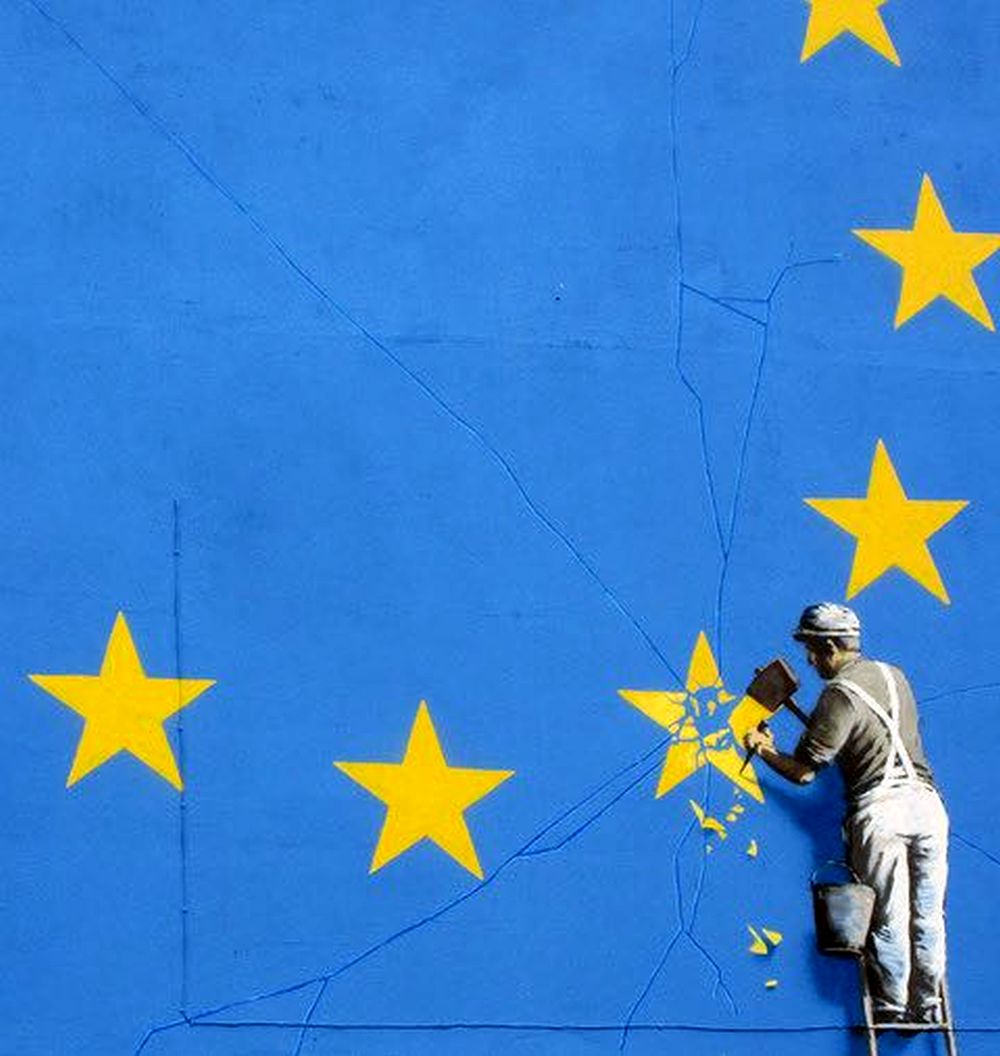
There he is! Old Banksie! Chipping away at the flag of The European Union; no longer a union between Britain and the rest of Europe. There is his latest mural - in Dover. How does he get them there?

Oh well back to being a country of servitude.


I have a lot of friends in America, a lot of them who read this, and I am constantly being asked about Brexit so without showing too many of my colours or opinions I will try to explain.

First of all the word: a new word, certainly not a beautiful word; there are beautiful words and one of my favourite beautiful words doesn't exist – it's capiliary. I love it and if you split it up and say capil I ary you should see and feel the rhythm of it as the real word is capillary. Baldy old capillary – if it was Spanish it might stand a chance in the aesthetics of language as they would do something with the double L – or even Welsh as they do things with the double L too but you have to almost speak with a lisp to pronounce a lot of the Welsh words like Llandudno – a sideways lisp as opposed to the tongue on the hard palette one which is the less rarer of the two.
But Brexit: two words really Britain and Exit. Good job it wasn't Ireland leaving as it would sound like an eating disorder. - think about it!
Briefly the EU started off as a pact between a few of the European countries who were at war and victims of war so France, Luxembourg, Italy, Belgium, The Netherlands and West Germany formed a union. 
It had various titles, over the years, and in 1973 Great Britain joined through the then Conservative Government.
The Labour Party (Her Majesty's Opposition) were against it and when they were elected in to office, in 1974, they called for a referendum (a plebiscite) to see if the electorate wanted to stay in or not; the result was in favour of remaining and at that time the Brits called it The Common Market and to lots of people, including me, that is what it is still called.
But there were always moaners, people complaining about silly rules and which was what probably brought Britain's membership to an end.
That and immigration.
One of the things about living in Britain now, which I like, is that there is a variety of people living here from other countries. As well as people from the British Commonwealth there are people from the rest of the EU which numbers 28 countries.
So when we go out now, in the cities, we can meet a host of nationalities which, to me, is wonderful. There are beautiful women from all over the world, which I have noticed, and a lot of attractive men - which I haven't noticed that much. These inhabitants have introduced new food to the country. No longer do we have nothing to look forward to but a lamb chop with boiled potatoes and peas in the evenings, or some other kind of meat and two veg. Now we can, sample the delights of some of the most wonderful food in the world: Italian, Indian, Chinese, Spanish, Mexican . .oh you name it.
Today we will be eating Lebanese Food for dinner. Fifty years ago it was egg and chips.
So to Brexit: the right wing, since that first referendum, didn't like the EU. There were Euro Skeptics in the Conservative Party – the right wing – and they broke away and formed an extreme Right Wing Party called UKIP – the United Kingdom Independence Party – which called for Britain to withdraw from Europe.
Whilst they didn't win any seats in Parliament they nearly did; almost did - but they didn't. People usually complain about the British system of government with the first passed the post system but you know: sometimes it's useful if it stops certain people from being elected.
 But even though UKIP didn't win any seats in The House of Commons (apart from one they inherited) they were chipping away at Conservative Membership so after the election in 2015 the Coalition Government (Conservative and Lib-Dem) gave in and promised a referendum to see if the electorate wanted to remain or leave. 
This was to save The Conservative Party so last year we had the referendum and the vote – even though it should never have been for anything less that a 60/40 majority – resulted in a vote to leave.
It might seem strange to Americans that the Liberals would join up with the Conservatives but Liberals here are in between Conservative and Labour (middle of the road - no man's land) unlike in America where Liberals are almost communists and socialists – heaven forbid!!
But we were subjected to some of the nastiest people you can think of; one of them murdered a young woman politician who was singled out for attack as a "passionate defender" of the European Union and immigration. The murderer viewed his victim, a Labour MP, as one of the collaborators; a traitor to white people.
This was very hard to believe in this day and age in Britain.
So that's it – we, the royal we, are leaving. We will no longer have financial passporting, freedom of movement and some of us might not even be able to receive our pensions from abroad – we don't know.
In fact there's a lot we don't know - or didn't know - for instance leaving something that you have committed financially to might mean having to honour that commitment – like one hundred billion pounds (or even Euros) which is one of the things what we/they didn't know about before the referendum.
The number of British citizens registering to be citizens of other countries is at an all time high here – Ireland, Italy and Germany I have heard tale of, so that's the explanation.
I hope the people who voted to leave enjoy their lamb chops, new potatoes and peas.


Sunday, April 30, 2017

The Guinness Poster


I was asked about that picture, above, the other day – who did it? When was it? How did it come about?
Well:
I did a Guinness commercial about two blokes who go in to a bar and ask for two bottles of Guinness – here it is: https://www.youtube.com/watch?v=MzzPtypCrUE – I'm the one with the black hair.
When I did this I was less than two years out of drama school; I'd been in a soap opera, Crossroads, worked on one episode of The Newcomers and at Birmingham Repertory Theatre, so I was a little green, to say the least.
The other guy, Jeremy Bulloch, was a regular in The Newcomers even though I hadn't met him when I did my episode.
Originally the advertising agency, J. Walter Thompson, wanted some name actor with dark hair to be with Jeremy in the commercial – whoever it was they couldn't get him so I got the role after auditioning with a load of other actors. Just once, no call back, or anything else.
I remember thinking that the director was really good; he wanted us to be Laurel and Hardy and on most of the shots you see we did about 20 takes; easy as they had loads of money and it was like a big budget movie.
We shot the outside scene in Windsor, around the corner from the castle, and shot the interior in the afternoon at Goldhawk Film Studios in Shepherd's Bush.
We had a few goes at the exit from the shop before shooting it and the director wanted me to do something funny on the way out so I suggested hitting my head on the bird cage. I tried it and everybody laughed.
They were rather concerned that it was hurting me but I actually headed the cage, like heading a football, catching it on my hairline so there was no bother.
What I hadn't realised, and look what I say above - I was a little green – they wanted loads and loads of takes of me hitting my head.
Maybe about ten or so from each angle – close up, shot from the back, shot from the front, up my nose, the back of the head, you name it.
I kept hearing 'does it hurt?' well it didn't as I got used to it – but where there's no sense there's no feeling!
A month or so after that, I was contacted, through my agent, by the advertising agency who wanted me to do a photo session for the poster (above).
The Production Designer or Art Director, or whatever he was, on the commercial, liked the work I did and wanted me for the poster; I was to be paid, maybe two weeks of the working man's average salary at the time, per hour, so I accepted the job.
At the time we were living in Shropshire – we bought our first house a month before starting drama school with the plan we would sell when I graduated – so I had to go to Richmond in Surrey to do the shoot and unfortunately there was a rail strike on the day. They did suggest cancelling and doing something else with me in the future but I guaranteed I would be there and stayed with friends.
The studio was full of reflectors, for the photographer to use to reflect light at me, and in the corner was a full barrel of draft Guinness. The aforementioned commercial was for bottled Guinness but this was for draft and the only way you could pour draft Guinness in those days was from the barrel; the award winning widget came in the eighties.
All I had to do was drink about one third of the pint in one go, then they would give me another pint and I would drink another third.
The photographer used a Polaroid instant camera initially, to see roughly what the final shot would look like – no digital in those days.
I found these Polaroids the other day and you can see I'm drinking the Guinness even before we started shooting seriously. They'd already sorted out a shirt for me and I've just noticed I am wearing a ring. That was my dad's and it disappeared years ago – so nice to see it.
When they were satisfied with the angle they liked they started to shoot. One third of the glass each time.
This involved someone perfectly pouring a pint for me, which is no mean feat, and they would stop shooting when I had consumed the right amount.
Then we would pause whilst a few more pints were poured and on to the next batch.
At one point, nearing the end of the session, the photographer looked at me and I can remember him nudging the art director and pointing at me; obviously I had been drinking Guinness for four hours and doing little else so I must have been having trouble getting any more down.
'That's enough!' the art director said and we wrapped.
On the tube on the way home I asked him where he had found me and that's when he told me he had worked on the commercial. 'I thought you were flailing towards the end' he said.
What he didn't know was I hadn't drunk much Guinness before that day - but I've drunk plenty since!
That was it till about a year or so later; we were still living in Shropshire, miles away from a city or any kind of conurbation, when my family called and said I was on Guinness Posters all over Birmingham; others called me from London with the same story and my aunt in Manchester reported the same.
I called my agent and she sent J. Walter Thompson an invoice who paid me the poster fee.
When I next went to Birmingham I couldn't go too far without seeing the poster. They were everywhere you can imagine and I remember late one night I was on the number eight bus going to my parents house and the bus stopped on the corner of Stoney Lane and Highgate Road, in Sparkbrook and there, for all to see, was a huge poster near the bus stop.
It was a stop where the driver had to get out and turn a key in a time lock so I had time to go to the loo nearby.
When I came out there was a drunk standing looking up at the poster. 'Look at him' he said to me 'with his bleedin' long hair; sucking that pint.'


Sunday, April 23, 2017

The Tottenham Hotspur Mascot.

Big weekend, this, for football. Soccer that is for my American friends – Sarcre, as they pronounce it, trippingly on their tongues.

And what was the highlight for me?

Well the semi final at Wembley was good between Chelsea and Spurs and the latest news is that Aston Villa are beating Birmingham City 1-0 – in fact I've just heard they won.
Today Arsenal are meeting Manchester City in the other semi final – again at Wembley Stadium – but that is not the highlight either.
But . . when the players lined up to go on to the pitch, they each had a child with them, maybe aged about ten or so, possibly younger, of both sexes. They waited in the tunnel and I'm sure there was a lot of banter, some of the players of the opposing team hugged the ones they knew and liked (presumably).
And when the time came they all marched on to the pitch.
In these times when football gets a bad name because of some of the fouling and gentle kicks in the ankles and some drunken behaviour from some of them and sexual crimes against others, it's nice to see the guest mascot policy, where kids write in to get drawn from some hat, or whatever, for the pleasure of walking out with some of their heroes.
The Sunderland manager, David Moyes, was criticised recently when he half told someone off for asking a stupid question on air – you could hear the banter in his voice; the trouble was the stupid question was asked by a woman so suddenly it became a sexist remark. One person saying he wouldn't have said it if it was to a man; maybe not; maybe he would have given him a thick ear.
His team, Sunderland, have a mascot with a terminal illness. A little five year old boy who has cancer and has just recently had a set back by a new growth at the bottom of his back – the manager was obviously involved in getting Bradley Lowery to meet his hero, Jermain Defoe and here we have a picture of them. See how he holds on to Jermain for security:
But back to yesterday's game – the highlight for me was when the players stood in the tunnel, bantering, hugging and then marching on to the field of play. We noticed one of the mascots, a Spurs mascot, was marching rather smartly and proudly and then we noticed; he didn't have any legs. But out he strode with his heroes.
Here he is: Chelsea are in blue and Spurs are in white and the little lad has false legs:


Hardly noticed – but we noticed him and so did his family.

Saturday, April 8, 2017

the birds and the bees!

Well I woke up this morning – dat da da da da – actually a few mornings ago; this wasn't any where near dawn, I might say, and a bird was singing a familiar refrain. Singing a song for me at his own expense (to quote Bob Dylan); when I went to the window I could see him at the top of a tree in the garden about 100 feet high. The song he sang was that of a robin and I've only ever known them to be on the ground or near to it in bushes.

I looked through the binoculars and sure enough – there it was, the red breast.
He was singing and calling out for a mate – it's a strange thing when you see them chirp as the sound they make they make without lips. We have to use our lips to whistle but the birdie does it without a bother.
The robin is supposed to be a nasty bird, or so they say, but when I have seen them being aggressive it is to protect themselves or shoo away a cat or an intruder.
I used to wake in California to sun shine and palm trees and the birds we saw there were humming birds which is the only bird, they say, who can fly backwards. I spent a lot of time, when I first moved to LA, on the balcony, or near, trying to get a photograph of one.
These days it would be easy as I would just film them, if I could get close enough, and freeze the film when editing.
That's the way I do my head shots these days.
But getting back to the birds and the trees – the tree I saw the robin in is at the top of this page. On that branch at the very top. Bit of a change from the palm trees but it's a pleasant outlook.
Here is what it is like from the front through the window of my little office:

I don't know the name of those trees. Not the green one but the one with the blossom which disappears after a short time each year. 
We have two at the front which shields us from the bad air of vehicles passing which are about twenty yards from us. If you know the name let me know.
Here is the question: the bird at the top of the tree is only there calling for a mate – any mate.
How do we do that and will we, the male of the species, always be the pursuer?
When I was young I would meet girls at or on the dance floor. It was easy as I would only ask for a dance and then it was always up to me to ask the girl out or make a date or even ask if I could walk her home. That would be a yes or no – nothing more. I might push that if I got a no but that would be the male in me pursuing.
But I could have taken a tip from the bird. I could have walked to the front of the dance floor to the stage and called out – like the robin – or I could have sung – ditto and . . .but we actually do that sometimes. Isn't that why the rock singer gets up and sings?
The other place I would meet girls would be at the cinema; I would (with a pal) sit behind two girls – and I know they would see us coming because they would tell me – and ask them to come and sit next to us; or we would sit next to them.
Then after a while I would sneak my arm around her and sit like that for a while. Then the kiss.
When the film ended I would usually walk out with the girl and maybe go for a walk.
One time, when we got outside, both girls were a good 6 inches taller than we were so we kind of went to the public loo and disappeared out the other exit. That took us to the other side of the street and when we walked back we looked over and could see that the girls had disappeared too.
Another time at the picture house in Ladywood, I sat around with a girl and didn't kiss her. I just sat with my arm around her till the end of the film.
We walked to a disused cricket field and she said 'why didn't you kiss me in the pictures?' and I said 'because I was watching the film.'

It was Horrors of the Black Museum – well??