Showing posts with label cricket. Show all posts

Sunday, August 25, 2013

The Pitch!

cricket bats - good and solid willow.


The word pitch has loads of meanings: you can pitch an idea, pitch a ball at baseball; it can be the pitch you play on, as in football (soccer), or the cricket pitch which is the piece of ground between the two wickets at cricket, twenty two yards long and ten feet wide – the hallowed piece of real estate that no one will walk upon.
People jump over it in case their foot leaves a mark or moves a piece of the sacred sod.
A pitch at baseball is what they call it when the 'pitcher' throws the ball at the batter, trying to get the ball past him, and into the catcher's hands – or to be more precise – his glove. The glove being worn on one hand – the none throwing hand.

Here is the picture of a pitcher:


not not that one – this one:


in all truth does this look more dynamic?


or this?


or even these 2 images.

Those last two are of Frank (Typhoon) Tyson a bowler – at cricket. 

And this is what it looks like at the other end:


At cricket you have to bowl the ball and keep your bowling arm straight or it will be a foul as you are not allowed to throw the ball which you are at baseball.

You will notice that the pitcher – no not the jug – lifts a knee just before letting the ball go.

Now why is this?

I think it's when you lift the knee you have passed the point of no return and you cannot throw the ball at one of the bases if you see a batter out of his ground which is what you can do before lifting the leg.

It's the same as running someone out at cricket – in cricket two bases, in baseball three bases and the batter's box as in the expression think (or whatever) out of the box.

Yes there are plenty of sayings from baseball but probably more from cricket – a straight bat, a safe pair of hands, a sticky wicket, it's not cricket and many more.

The glove is worn on the one hand, at baseball, so the fielder can throw the ball with the other; however, at cricket, they don't wear a glove at all even though the ball is heavier (between five and a half to five and three quarter ounces as opposed to the baseball which is five and a quarter ounces) apart from the wicket keeper which is the cricket equivalent of baseball's catcher. He wears a pair of gloves.


The difference in weight between the two balls means that the cricket ball can be thrown further than the baseball which makes the long fielding at cricket better than long fielding at baseball but baseball's close fielding is far superior; there is nothing so spectacular as the double (or even triple) play.

The object of both games is to score more runs than the other team; in cricket you can have a drawn game – that is when the time allowed for play runs out before the last batting team are all out – or a tie; that is when both teams score the same amount of runs. 

If this happens in baseball they play till one of the teams has more runs than the other when they have both batted for the same amount of innings; this can sometimes mean playing after midnight.

As a general rule, batsmen at cricket think they can play baseball – but they can't. In baseball when you hit across the ball and you have to run when you hit it.

As a general rule, batters at baseball think they can play cricket – but they can't. In cricket you get behind the ball and hit it with a straight bat but you don't have to run; you can play defensive – unheard of in baseball.

Two great games, though, and I am privileged to know both of them so I know what a 'curve ball' and a 'googly' is.

By the way in cricket it's an innings and in baseball it's an inning.

A run at cricket is when you run to the other end of the pitch (you know what pitch means) and the batsman (batter in baseball) at the other end reaches the wicket at the batsman's end who has just hit the ball.

A run at baseball is when the batter (batsman in cricket) has run all the way around the triangle.

Here's the triangle:

 And here's the cricket pitch:
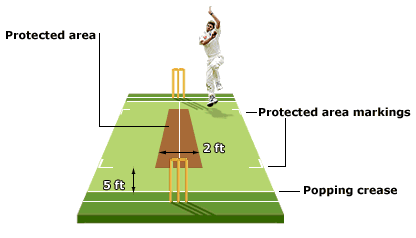
The bowlers at cricket bowl fast or slow. The fast bowlers 'swing' the ball and when it bounces it can go anywhere and when they bowl slow they 'spin' the ball and that can go anywhere too.

Give yourself a treat and look at one of the greatest bowlers ever, the Australian Shane Warne bowling the ball of the century – see how good it is on the replay in this clip which is about one minute long:


I hope all this is clear?

Oh! Not to worry – I hope you enjoyed the pictures. Here is a simple explanation of cricket:

The aim of cricket is simple - score more than the opposition.

Two teams, both with 11 players, take it in turns to bat and bowl.
When one team is batting, they try and score as many runs as they can by hitting the ball around an oval field.
The other team must get them out by bowling the ball overarm at the stumps, which are at either end of a 22-yard area called a wicket.

A batsman protects his stumps A batsman protects his stumps
The bowling team can get the batsmen out by hitting the stumps or catching the ball. Other ways of getting out
Once the batting team is all out, the teams swap over and they then become the bowling side.
Each time a team bats it is known as their innings. Teams can have one or two innings depending on how long there is to play.
The Ashes Test matches are over five days so England and Australia have two innings each to score as many runs as they can.
Whoever scores the most runs wins. But a cricket match can be drawn too.
That happens when the team bowling last fails to get all the batsmen out..


Here for baseball:

A baseball game is played by two teams who alternate between offence and defence. There are nine players on each side. The goal is to score more runs than the opponent, which is achieved by one circuit of four bases that are placed on the diamond.

When it boils down they are the same game but that's the way the Americans play it; they misread the memo.

Here are the heroes; two in baseball and the other at cricket; these men will never be replaced:
Ted Williams of the Red Sox and Joe DiMaggio of the Yankees.

Ian Botham - a hero for all time (a sporting hero, that is).


Thursday, December 24, 2009

The Day I Met Peter O'Toole.


I hadn’t played cricket for years when I suddenly got a call from a friend; he was coming up to Northamptonshire to play and there might be a game for me if I turned up: “Oh by the way” he said - Peter O'Toole is playing.


The call came on a Sunday morning and the game was to be that afternoon; I searched around for some kit and found my old cricket boots, a white shirt and my cricket sweater; no white trousers, I’m afraid, but I didn’t want to look too keen in any case; that wouldn’t be cricket.


The things people like about playing cricket are batting and bowling and when you get a game with a new team those are the two things they never let you do; you have to field and go in at about number nine or ten; and as for bowling? Forget it!

Looking back on that now it amazes me the way we stood for it; when people ask if you will help them out and make up a team you should say “yes! If I can bat or bowl.” But again – that wouldn’t be cricket would it?


I had promised my son that when the famous England international cricketer, Ian Botham, came to Northampton to play the local team I would take him; I asked him if he wanted to come and see Peter O’Toole but it was met with a negative response – who is Peter O’Toole? he said.

The field, where the match was due to be played, was in another village but was was easy enough for me to find as I was very familiar with most of the sleepy picturesque villages of Northamptonshire.

A few of the players were already there when I arrived and it was good to see my friend Nick; we first met when we appeared together in a national tour of a Mike Harding play “Fur Coat and No Knickers” but I hadn’t seen him for about a year.

My cricket boots and sweater were in the car when we greeted each other and I asked him how he got involved with Peter O’Toole: - It's his nephew’s team; he said he plays quite often.

About ten minutes or so later Peter O’Toole arrived; he didn’t just turn up in a car with others or sneak in, he arrived in the truest sense of the word; he arrived; he was with his nephew in an open top sports car; even before he got out of the car he dripped with charisma, eccentricity and just basic star quality; there was no mistaking that this was Lawrence of Arabia.

He didn’t look too healthy; a bit thinner than I had imagined and very pale; but it was Peter O’Toole all right; he smiled as he emerged from the car and headed towards the dressing rooms.

As he greeted everybody it became obvious that this was no mere mortal; this was the bon vivant on his day out, smoking a cigarette through a long holder and not sparing anyone in his wake that charming and attractive smile.

I was glad I had left my cricket gear in the car as both teams were in full attendance and all members were fully dressed in their whites; I would have stood out like a sore thumb in my jeans in any case.


I managed to get a bit of a “field” in the warm up though; the part where everybody throws the ball as hard as they can at each other to see how brave or foolish they can be. Peter O’Toole seemed to be catching the ball okay which surprised me as I didn’t even know he played cricket.

While we were having the warm up a few cars arrived and out of the cars came a few strange looking people of all shapes and sizes; yes the press and local radio reporters.

When they spotted Peter O’Toole the cameras and the shutters started buzzing and snapping; this was in the nineteen eighties when the paparazzi didn’t quite have the reputation they have today so nobody was that alarmed.

The time came for the toss: Peter O’Toole’s team would bat first and Peter and his nephew would open the batting. The opposing team took the field and went into the ritual of trying to knock each other’s heads off with the cricket ball; the umpires, who in that class of cricket came from the lower order batsman of the batting side, took to the field and we were ready to go.

When Peter O’Toole and his nephew emerged from the dressing room there were two other batsmen with them each carrying a bat and each walking towards the middle with the nephew and his Uncle Peter; it seemed that both Peter and his nephew had leg injuries and needed runners.

It was a strange sight seeing the four of them heading towards the middle followed by about three or four press photographers; they surrounded him snap snapping and flash flashing as he took his guard and when he was ready he looked at them; he didn’t say anything, he didn’t have to; they got the message and sloped off to the sidelines.

The opposing bowler had marked out his run and was making adjustments to the field as everybody waited for the first ball; Peter O’Toole looked valiant as he waited for it, his runner was standing out at square leg and his nephew’s runner was standing next to the umpire at the far end with the nephew, himself, standing as far out as his uncle’s runner. At one point it looked like more batsmen were out there than fielders; everything was ready to go.

The press kept quiet and we all looked to the field as the bowler came bounding in; when he reached his maximum speed, which coincided with his arrival at the wicket, he let the ball go at the top of his arch and the ball seemed to bounce at lightening speed half way down the pitch; Peter saw it coming and played it defensively on the back foot and it travelled towards a close fielder: “stay” “no” “stay” “wait” could be heard and then everybody laughed.

If they kept that up through the game it would be like the Reginald Perrin yuppies “super” “great.”

The batsmen and runners got together; they had to make up their minds as to who was going to do the calling when a run was possible; they huddled conspiratorially together then they laughed again and went back towards their places; suddenly they stopped and got together again with a kind of “don”t forget the…..’ then they were in a huddle again till they laughed and parted to take their positions.

Peter O’Toole played a straight bat throughout; he was exceedingly accomplished and hit a few cracking shots against bowlers who were trying really hard to get him out; I particularly remember a few off drives and a couple of boundaries.

Each time he did this the bowlers tried even harder to get him out and the few onlookers cheered and jeered.

Eventually it had to happen; he was out. I’m not sure how many runs he scored but it was a good knock and he got a tremendous amount of applause as he walked off with his runner trailing behind.

The press pathetically took his photograph as he reached the edge of the field and he very obligingly smiled and acknowledged the applause by raising his bat as he headed for the dressing room.

A girl radio reporter, with tape recorder on her shoulder followed him into the dressing room.

I was sitting just outside and I’m not sure what Peter O’Toole said to her – it sounded like geee yaa ferr yah here! Whatever it was the girl radio reporter came out of the dressing room like a greyhound from the trap.

After a while the great man emerged; carrying the cigarette and holder, and wearing a small towel around his neck; he came and sat next to me and as his limbs hit the bench I could feel the heat from his body permeating the air.

The girl radio reporter came and stood in front of us blocking our view of the game “Darling! Do you mind?” he said.

He was very nice and she moved away. I was very envious that I wasn’t playing and sorry that I hadn’t played for years as the smell of the willow and surgical spirit mixed with the cool Northamptonshire air, the general camaraderie of the players around me and the general atmosphere of the day, made me want to seek out a team that was looking for a has been.

The conversation for the next hour consisted of “well played” “that was never out” “how many do we have now” to “oh well; it”s our turn now.’

And there they were; going on to the field to try and bowl the other team out.

Peter O’Toole was the wicket keeper and played a good game in the field too. There didn’t seem to be any sign of a leg injury; but why would there be? This was the man that took Aqaba by land and the opposing cricket team would be easy meat for such a legend and the team did indeed collapse giving the Peter O’Toole XI the game.

He came back to the dressing room and when it was time to go, he warmly shook my hand; as he did this he seemed to look me up and down as if he was the major and I was the trooper under inspection.

Then off he went to China to work in The Last Emperor; he didn’t see his photographs on the front page of the Northampton Chronicle & Echo the next day; the photos made him look about twenty years younger and twenty pounds heavier.

The day coincided with Ian Botham’s visit to play Northamptonshire County Cricket team in their annual game at Wellingborough School; in this game Botham hit a record number of sixes which was on the television news that night but there wasn’t one photograph in the Northampton newspapers to record this great feat; the photographers were all taking shots of Peter O’Toole..