Monday, October 14, 2013

Acupuncture and dancing on my balls!

The drama school I attended (the back of).
I was in Los Angeles in April and whilst there I took advantage of an acupuncturist I know; he is one of the doctors/professors who works at an acupuncture college and, as it's a college, you get really good treatment; and it's cheap.

If you've never been you should try it; it doesn't suit everybody but I can honestly say you don't really feel the needles going in, if that's all that's preventing you from going.

The first thing they do when you get there is take your pulse with three fingers; they believe there are 3 pulses in the wrist. Next they ask you to stick your tongue out – right out; then they examine it very closely and usually, because they are students, they ask another student to look at it.

Most of the students and staff are Chinese and Korean; they have a very friendly manner and make you feel very comfortable; when they have asked you about your symptoms they ask the doctor to come in and he takes a look at your tongue too.

The doctor I like cracks jokes in Chinese to the students and they always laugh; I often wondered if he was referring to me when laughing and joking but I'm assured he wasn't – because I once asked. 

He did tell the students in April that he'd been treating me for 8 years.

He is the one who puts the needles into your body and sometimes he recommends 'cupping' but not before laying you on to a bed (with the needles sticking out of you), covering you up with a tiny sheet, putting a tiny light/heater on and going away.

When he comes back he will massage the parts of the body that are in pain and sometimes stick more needles in.

Cupping, by the way, is one of the most ancient and successful techniques to cure many problems.
Cupping.

Chinese medicine principles state that stagnation of blood is the cause of many pains and diseases. Cupping therapy clears up the stagnation and stimulates the blood flow in the affected areas. Due to its very nature, it also clears congestion in the chest caused by colds and ‘flu. It leaves marks on you body rather like love bites – hickeys!

When they go away and leave you with the light/heater you go to sleep and it's the most wonderful sleep in the world and I got to thinking, as I lay there, that there was another time I would just 'go to sleep.'

When I was at drama school we studied (did) dance with a teacher called Henrietta Fairhead; I have just looked her up and she is mentioned on Amazon as the author of some books on dancing. We studied ballet, tap (in our ballet shoes – I kid you not), mediaeval dance and movement and at most of the classes we were taught how you relax.

This involved lying on the wooden floor whilst Hettie's assistant, on the piano would play Air on a G String which was so relaxing I would sleep; I think everybody else did too even though we were supposed to be doing something else meaningful – I don't know – transcendental meditation?

The classes consisted of students all shapes and sizes and we would do the most strange movements and poses you could imagine. 
 
I remember stretching out, pointing my two arms into the air and at the command 'let go!!' would collapse it all with my hands on the floor. Once in a while I would catch the eye of a window cleaner and I could see the funny side of things and I think the rest of the class did too even though they would pretend it was very meaningful and serious.

In ballet we learned the first position, second, third and fourth and we would gracefully jump in to those positions; then we would straighten up and dance on the balls of our feet.

The teacher would say 'come on class; bounce up and down on your balls!'

She knew what she was saying, I'm sure she did; I know she was a very fit old spinster but we couldn't laugh out loud (lol) so we smiled and she saw us smiling and realised we were having the time of our lives; the window cleaner would have amusement from it and I'm sure he took it up one of the days – Unfortunately I'm sure one or two in the class took up window cleaning!!
This is a view from the front - notice the bars!!!!


Monday, October 7, 2013

Debt.

When I was a little boy we lived in England and people with children attracted a universal benefit called Family Allowance; if you had one child you didn't get any but after that you received a certain amount of money for each child.

People with fifteen children, who were few and far between, would be featured on television and tabloid newspapers, as interesting individuals who had all the babies just to attract the Family Allowance. This infuriated some people, mainly those with no children, who thought, in their tiny minds, that they, the people without children, were subsidising the people lucky enough to be blessed with them.

Nothing could be further from the truth, of course, as people with lots of children were, actually, rearing future tax payers so the man with, say, fifteen children would be donating quite a few tax payers to the economy. We'll say 10 as the other five might be housewives (what's that word, home-maker?) or people who can't work for whatever cause. So they are giving, shall we say, a few million to the future of this country.

Let me get it straight – people with 15 children were so rare that they were actually noticed and written about!

When I studied sociology, 30 years ago, it was estimated that with loss of earnings and the general bread and buttering of children the average parent would spend £80,000 per child, up to the age of 18, bringing them up – school uniforms, holidays, food and whatever – and that's without the expense of college - so let's hear it for the parents.

Family Allowance changed its name over the years to Child Benefit; changed its name like everything else; this gave some people the idea that the money was for the children – WRONG again!! It was to be shared by the family and administered by the parents.

This year it has been decided by the mighty and the powerful to means test this benefit. Will the Labour Government reverse this – I doubt it!!

The weekend just gone was the last day to register for self assessment for Child Benefit. This is for the people who have one wage earner earning £50,000 per year – if both parents are working and earning £45,000 each they don't have to register – stupider and stupider aye??

If they are late registering they are fined – all the child benefit they have received this year; what a friendly old government aye??

How much do they get? For the first child you get about £20 per week and the second £13 and so on; that means if someone doesn't register they will be paying £820 in fines, if they have just one child.

Why are they doing this? Why are they means testing a universal benefit in any case? Oh yes!! Austerity! Cuts!

We are in debt! There is a deficit.

I was talking to a doctor in the hospital recently and I asked him about the threatened closure of Lewisham Hospital and their big debt and I asked him who they owed the money to; I said - to whom do they owe the money?

He lifted his eyebrows at my use of the word 'whom' and said – I don't know!

I remember I worked in the car industry for a year before going to drama school and they would talk about one department owing another department money; it never really existed and no money ever changed hands and instead of caring about the quality of their vehicles they were ruled by the money men and eventually went out of business with the rest of the British Car Industry.

I also remember the BBC when they made great programmes: ground breaking drama, documentaries and series like Man Alive, Horizon and the rest of them Then they sent in a trouble shooter to sort things out and we now have a record amount of cookery shows, antique shows, property development shows and loads of reality shows like The Apprentice. I'm sure there are others besides The Apprentice but I can't think of any off hand.

So I wondered about our debt, our national debt and the so call deficit – here's what I came up with: I know that the Chancellor of the Exchequer lent money to the IMF last year but I don't know how much. I know he made one loan of £10 billion. Now that got me thinking that we (Britain: hey!! I'm back!!!!) have a share in the IMF; possibly the world bank too. So don't we owe some of this national debt to . . . . . ourselves?

Last year the accumulated external world debt was $72.8 trillion – now that is the accumulated debt which means it's not that much at all. If I owed my son £1, my son owed his sister £1, she owed my wife £1 and my wife owed me £1 we would have an accumulated debt of £4 when there is only £1 involved; so Gawd knows how many trillions it really is.

The other thing is, if you added all the countries together, all of them on earth, add all their GDP together, it comes to, or should I say, came to (last year don't forget) $71.8 trillion; bit short of the old $72.8 aye?

The difference between the two figures is the debt to GDP ratio.

Now I got these figures from an article I read, and I have to trust that as I can't remember who wrote it.

In that article, I took down the following note: since all this money is owed to entities within this global community, it could just as credibly be said that "the world owes this money to itself", and so owes nothing.

So there!!

Of course it's more complicated than this as some countries have huge huge debts – Japan for instance. Here's another note I took from the article: Japan has the largest national debt-to-GDP ratio in the world – over 230%. It is heavily in debt, compared to its product, and yet in a position to lend to the world's largest economy. In fact, Japan's position is much more stable than countries with lower ratios. One of the key factors contributing to this stability is the fact that the vast majority of this debt is owed internally – it is Japanese citizens and companies who have been funding Japanese debt. Of what it owes externally, its largest creditor is – can you guess? – the USA.

Why then, if we owe this money to ourselves, do we even bother the enormous amount of money it will cost to administer the two tier system of child allowance? Why do we bother to fear the so called influx of Romanians and all the other new members of the EU next year as put about by UKIP – by the way, for my friends in America, for UKIP read Tea Party!!


Sunday, September 29, 2013

Locked in the Cannes!

La Petit Carlton, Cannes (not there now I hear).

A little story for you:

The other day I was talking about being locked in various places and today I noticed the blog post I wrote in 2013 was being viewed. So here it is again:


I have been to Cannes a few times; Cannes, in the south of France, that is; well four times, actually, and each time I stayed in a flat near La Croisette which I really liked; I think I was in there by myself twice and definitely shared twice.


I travelled three times with round trip flights from London to Nice and the other time I drove there, with two posh chaps who were old Etonians, and on that particular trip I caught a train back from Marseilles which arrived at its destination in the north of France smack on time.


You may ask why I came back by train? Well the old Etonians left me there and I had to find the money to get back – moral of the story? Never trust an old Etonian! They're not even trusted amongst their own posh fraternity; the 'public schools' of England.


The upper classes tend to think, and they may be right, that Eton and Harrow are populated by the Neauvo Riche as they're the only public schools the plebs have ever heard of – who cares, aye?


I was there trying to sell the idea of my film being a TV series; since it's been on YouTube, by the way, a few people have contacted me and said it would have made a good series – too late, I'm afraid – those days are gone, Joxer 'dem dayz is gone!! Have a look if you wish https://www.youtube.com/watch?v=WpWmesv5nVA&t=746s&ab_channel=JustMaximumPublicity


That's a new cut by the way in 2014 where I dubbed a scene between two of my friends who are both now dead – Ron as the rabbi in New York and Jeff as the New York dealer at Portobello Road.


So why am I writing about this now?


I was listening to one of my favourite programmes on the radio, on Saturday, and they started talking about people's experiences of being locked in places and being rescued by the fire brigade or whatever.


On one particular trip I was locked in somewhere three times in three different places; this was one of the times when I was staying in the flat alone.


I loved Cannes and considered moving there on a permanent basis; in those days I smoked and I would inhale those delicious Gauloises and blow the smoke out over anybody within passive distance; but then we all smoked so they didn't care – well most of us did.


We could even smoke on the plane and each time I flew back to London we nearly drank the plane dry – pissy, hazy journeys with the Gauloises/Gitanes air making it even hazier than I can remember!!


I had a favourite super market, in Cannes, which sold wonderful Olive Oil, I knew some street markets too, that I would frequent and my local drinking hole was Le Petit Carlton; which was a wonderful deli/restaurant/bar with a very rude waiter called Pierre – well he wasn't that rude he just gave as good as he got and we were very fond of him.


I remember the French Onion soup, the millions of French Fries that were served up with each meal – I was so French it was unbelievable; but I could hardly speak a word of the language. I can speak a little bit of Spanish, enough to get by but French?? Sounded all Greek to me.


One time I was in the apartment and someone knocked on the door; I answered and a desperate looking man, with five and a half days of beard growth, got through a whole sentence before I could get the word in that I didn't understand him - mon chaton il disparu, he said.


Sorry, I said, no French no French!


Then he started making susshhhh, noises and waving his arms about saying shooo sheee shaaa!!


Sorry, I said.


Mon chaton, he said, looking passed me, Mon chaton!! – then went.


What the . . . who the?????


Not long after that I saw a cat on the balcony; I might have felt French but I knew they had rabies in France, every cat, every dog – all animals there, all had rabies. Well I would think this, wouldn't I, as we were propagandised to all the time by the British Media about Rabies!


I saw the man later and he told me he had brought his cat along from Paris and it had escaped from his apartment – but he got it back; maybe that man was some kind of omen as strange things seemed to happen later.


One evening I was on my way out but when I tried to open the door the key wouldn't work; I was locked in. It was the only way out; there was a balcony but I was five floors up, I didn't fancy doing a spider man down the side of the building then I realised some friends of mine were staying on the floor above; I prayed that they were sober or even in. In those days we didn't have cel/mobile phones and I hadn't taken the phone number of their apartment yet.


Their balcony was almost directly above mine, just one over, so I went out and called out to them but I couldn't make them hear.


But I could make the man directly above me hear who didn't speak English; I found this out earlier, of course, as he was the man with the cat.


Non Engleeesh, he said, mon chaton bon!


Mon chaton bon – mon key, kay que not bon not work kaput!!


Then I heard them stir in my friends' apartment – hello matey, said my pal, what's going on?


I explained and suggested I throw the key up – No matey, he said, I'll never catch it.


He came down to my door and I slipped the key under the door to him hoping it would work from outside; it did!


Apparently if I'd broken the lock, the management would have sent for a locksmith and I would have had to pay the bill.


In the day time I would wander around the Le Palais du Festival bumping shoulders with the famous and not so famous then I would go back to the apartment at around 5:00, take a nap, and then go out in the evening trying to sell my idea of a TV series, usually ending up singing either The Wild Rover, in La Petit Carlton or Beatles songs in the Carlton Hotel with a load of Germans who sang exceedingly high which ruined my throat; it was a hard life in those days, I can tell you.


The pianist at the Carlton Hotel got to know me and would play Danny Boy whenever I entered the bar. He was quite famous, American, and he played on a regular basis at Carnegie Hall.


One evening I came back to the apartment building and entered the building with a woman; we both walked to the lift which was an old style lift/elevator with see through iron gates; like this:


I didn't speak French, she didn't speak English so we pressed the buttons of the desired floors ourselves and when the lift went up passed the third floor it came to an abrupt stop!


We pressed the buttons, rattled the doors and she screamed!


She screamed and screamed and screamed and screeched!


Then she started moving around the lift screaming; I didn't know what to do – I couldn't touch her to stop her as she might have accused me of something.


She screamed so loud that it was as if I was attacking her.


Everybody heard her and everybody came out of their doors and a load of French was spoken and shouted and I tried to get a word in and the manager said things to her and she screamed back unintelligibly and I . . .. what could I do?


They managed to get us out and I went and had my nap – by the time I woke up my friends had gone out so I decided I would take a shower and go and eat by myself.


I found a small restaurant near the harbour and took a seat on the patio but . . . I needed to go to the loo; it was a single loo so I locked the door and when I had finished it wouldn't open; I was locked in again.


I banged on the door and shouted; nothing! I was in the cellar and the staff were on street level.


Eventually someone came down and asked me something. I don't know what I was asked and they didn't know what I answered but eventually, after a lot of scraping and tapping and bumping they got me out; they couldn't stop laughing and neither could I – till they presented me with the bill for my food; I would have thought it might have been on the house.


I remember saying to the waitress that I was sorry that I could only speak English but that I was learning French; Moi aussi, she said, Moi aussi.


Obviously she meant she was learning English.


Sunday, September 22, 2013

Why! Billy Connelly and My Son's Carp!

Billy Connelly
I noticed recently in the wonderful tributes to Seamus Heaney his pronunciation of the wh words; whale, wheat, why, when and the wonderful while or whilst etc.

Seamus pronounced 'why' correctly, as most of the Irish do as hwahy – try it!

The aitch is on the breath of the double-u as the lips pucker themselves together for the double-u plunge – fun isn't it?

By the way, as we are at it, aitch is pronounced aitch – not haitch as I have heard a lot these days.

The other place where it's pronounced correctly is Inverness in Scotland; in fact it is said that the best pronunciations in English are in Dublin and Inverness.

Wouldn't believe that would you?

But that spreads to the rest of Ireland and Scotland; thick accents notwithstanding.

When people like Noah Webster come along and try to change the spelling of the words to make things simple for the Americans they are obliterating the origin of some words. I mean why did he take the 'u' out of colour; the 'u' tells us where it came from – 1250–1300; Middle English col ( o ) ur   Anglo-French  ( French couleur )  Latin colōr-  (stem of color ) – I mean why didn't he leave things as they were? It was a pain, when I lived there, that I eventually ended up confusing the two.

 
Someone said to me at a party one night that the 'U' was only put in to words by the English to be flashy or pedantic; I didn't comment on that at the time and I won't now.

When I said 'people like Noah Webster come along' I mean what I say 'come' along, present tense, as they still do; I knew a teacher there who wanted to see Americans spell catalogue as catalog – now what looks better on the page in this day and age of shortening everything, BTW, the former or the latter?

Yes, BTW, my little joke – or joak, to use a private family joke!

My daughter was talking to one of the school mistresses at her son's school, the other day, and she asked her about the basketball court and the school mistress said - don't you mean the multi-sports hall?

Give me a break!!

Seamus Heaney also pronounced Drogheda the way it's spelt without the 'g' but the very posh English say Droyida – they also pronounce Daventry and a town in the north east of England in a funny way too but I think they do that as a test for 'pretenders.' They say Dayentry, by the way.

Do people in other languages have this kind of trouble? I mean do the Mexicans have Mexican Spanish and the people from Quebec and various African countries have their own French spellings? Are they allowed to say actress in their languages unlike us; The Guardian always refer to females as actors – I know a lot of women don't like the word actress but it isn't exactly a word like poetess or authoress is it? It always seemed silly to me, when old dames die like Dame Wendy Hiller, being described as the actor Wendy Hiller. It seems okay for someone like Germaine Greer or even Vanessa Redgrave but Wendy Hiller?

As I write this a profile of Billy Connelly is on the radio and he, as a Scotsman, is pronouncing his 'wh' properly; the big Yin is not too great at the moment with the recent announcement of his prostrate cancer and his Parkinsons. Ironic isn't it, and he would point it out, that he shot to fame on the Michael Parkinson Show in the 70s. 

He came on to that show, the first time, and told one very famous joke and that joke, that one joke, made him a star. 

When he got back to Glasgow he was spotted at the airport and a crowd of people saw him and started to clap; there were only about 4 TV stations in Britain at the time and he hadn't quite reckoned how many people were watching and how he would affect people. 

I remember thinking he was the funniest person I had ever seen and when I went to see him live in the theatre he was even funnier; he wasn't restricted by language and he could say anything he liked and that's the problem with censorship – it's for the narrow minded; I mean what's the matter with a word; what harm can it do? If we welcomed words, rejoiced in their original spelling and meaning, things would be easier for everybody; there is not one name you can call me which would cause me offence. I know I'm white, reluctantly middle class, medium height, regular looks but I've been called lots of things in my life. When I first started on the post office the old sweats would ask me if I was going on my holidays – they were referring to the bags under my eyes and I hadn't quite worked it out what they meant. 

Then I was called the Mekon (I have a big head), the green man (I was usually pale) and the incredible hulk. I didn't figure out the last one till fairly recently; apparently I looked like the guy who played him on TV – the David Banner side to him.

I do feel it for Billy Connelly as my mother had Parkinsons and I do realise that the Americans, with their lack of patience for foreign accents, have never seen him at his best but I have and I'm not putting that joke down here – you can look it up – but I can put a picture of my son with one of the fishes he caught over the weekend. That's a Carp and I think it's probably 15 – 20 years old as the fishermen, or anglers, look after them over the years.

Monday, September 16, 2013

Cuts, Austerity and idiocy!

Pinner Park.
Well there's not much to say at the moment about anything unless of course you are interested in the fact that the British Government are actually selling the post office; can you believe that – they are selling the one stable thing that is beginning to work properly and which is starting to make money!

Not that making money is the main thing the post office is there for, it's supposed to be a service and not necessarily a money making machine.

The British Post Office is maybe the only post office in the world – maybe – that delivers first class mail the day after it's been posted to all parts of the country.

That is impossible in America because of its size but I know you could mail something in Santa Monica on one day, first class, and it might not reach its destination five miles away in the same week. And by the way they have no plans to privatise the American post office and that is the superior capitalist of countries – good or bad that's what it is!

Someone said on TV the other night that the modern post office is out of date – people buy things from Amazon and E Bay, these days, she said, and we can't wait for the post office to open to return them.

Can't wait for it to open???? Return them????

Give me a break!

Oh by the way – they say they are not selling the post office at all – they are selling the Royal Mail.
The Royal Mail is 497 years old and is owned by the government and every time they argue about it on the radio or TV the Conservatives say they are not selling the post office they are selling the Royal Mail – over and over they say this as if the one is nothing to do with the other.

Here's what it says on good old Wikipedia:
Royal Mail is the postal service in the United Kingdom of Great Britain and Northern Ireland that, as of 2013, is 497 years-old and government-owned Royal Mail Holdings plc owns Royal Mail Group Limited, which in turn operates the brands Royal Mail (letters) and Parcelforce Worldwide (parcels). Post Office Ltd (counters) and General Logistics Systems, an international logistics company, are wholly owned subsidiaries of Royal Mail Holdings.

So they're not selling the post office.

If you go to Ealing, for example, in west London, there is no post office at all. It has been closed and put in to the back of the newsagents and stationers WH Smith. In Eastcote the post office is for sale and we – the population – are letting it happen.

Got it? Good!

As I say – not much to say at the moment about anything unless of course you are interested in the austerity policies and all the other government cuts that we don't really understand; let me give you a silly example.

Harrow Council have decided to close the public lavatories in the parks – it saves money. If the loo is closed you don't have to employ people to lock and open them each day; make sense??

Outside the loo, in the park, people take their dogs for walks and to help them keep the place tidy and encourage the owners to make sure the place isn't covered in defecation – shit - (I wanted to put a different word instead of defecation and the word 'shit' came up; made me laugh) – yes to make sure it's tidy the council provided bins. Well now, to save money, they have taken the bins away; it saves paying people to put them there each day, empty them and take them away.

These facilities – the public lavatories and the bins – are in the parks which usually get locked each evening and opened the next day; not any more. To save money Harrow Council are going to leave the parks open to save people having to open them in the mornings and locking them in the evening to save money; they don't think any harm will come to the parks as people would vandalise them whether they're locked or not so they say.

So they say!!

When darkness comes people will go in there; maybe lay around and drink? Smoke a joint? Maybe lay around and fornicate? Maybe lay around and . . . . no lavatories??? No bins for the dog shit??? No light??? I'll leave it to your imagination as to what state the clothes of the vandals, fornicators and boozers would be in by next morning; but will it save money?

If they hired people to do these jobs – let's say they pay them, shall we say, £650 per week and let's say, to be totally outrageous, that the people earning this money decided to spend £600 of that, each week, on booze and fags and squander the rest, the money that they would spend would attract a lot of tax which would go straight into the government's coffers and . . .

Well, you know, they are making stupid cuts to the NHS; spending many billions refurbishing hospitals, then saying they're not working – not paying their way - so they close them down and sell them.

True!!

In Northwick Park Hospital –  still in Harrow by the way – they are closing down the rheumatology department – closing it down!!!

So come on – come on Generation X or the Generation after that whatever you are called – the boomers have done enough; it's time to stop this lot.

Do you believe, American readers, that in Britain we have 'Virgin Medical' trying to edge its way in to the National Health Service and ruin it.

Nuff said!!

Monday, September 9, 2013

Amazon.

 The River Amazon - seems to go round and round.
A lot of people liked my post last week about acting; it was actually a revue I wrote for Amazon which I copied and pasted here – I thought it might be of interest.

A word about Amazon; in Britain it's http://Amazon.co.uk and America http://Amazon.com – the same derided company both sides of the Atlantic. In France, I believe, they were prevented from selling stuff with no postal charges as they were undercutting the book shops.

I have friends who never use Amazon; they never use them because of the loyalty they feel to the book shops and believe Amazon are closing them down.

That's a fair point.

Over the years I have had friends – other friends – who have worked in book shops, including a famous one in Charing Cross Road, who have been on slave wages; working for next to nothing, being supervised by the supervisor from hell and working very long hours. Well why didn't they get a job somewhere else? Yes, why?

Now those same book shops have been given a kick up the arse by Amazon and at the same time Amazon has saved the post office; Ebay also saved the day for the British Post Office and has put them into a decent profit position so now the government wants to sell off the post office counters to large stores or private enterprises now they have Amazon and Ebay on board for the mail side of things. Apparently the post office counters don't make a profit but the parcels side does; good old Amazon, good old Ebay.

I remember when Amazon first started; they were making no money at all but even so they were sponsoring the Charlie Rose Show on PBS; every night Charlie would espouse their virtues – what a great company Amazon is, he would say, and the rest of us who had read about the stocks wondered just how long it would last; just as we are now wondering how Netflix has lasted so long; that's a very strange company but it hasn't been taken over yet by Google like - YouTube.

But there is a good side to Amazon; not only did they help Charlie Rose, they help first time writers to get started and first time film makers with their film festival information company which is a subsidiary of the Internet Movie Date Base (IMDb.com) which is an Amazon Company. That's a place where all actors have to be aware of so things go around in circles don't they.

But those old book shops hardly ever helped writers to get started. I say, hardly ever as there may be a few – not that I know of any – who are helping new writers and novice novelists like me; but I haven't heard of any so that's just to cover myself.

Well that's it for today and here's a picture of a man who won the Nobel Peace Prize!


And here's a man - in one photo with John Lennon, no less was was an anti war campaigner:


Such is life - going round in circles.


Monday, September 2, 2013

Reclaiming the Stanislavski Approach.

The movie 'Stagecoach.' - good acting? natural.
 
An actor I used to work with, many years ago, John Gillett, has written a book on acting; it's called Acting on Impulse: Reclaiming the Stanislavski Approach: A Practical Workbook for Actors.

He wrote it a few years ago and I have just found it on Amazon.

Oh dear; another book about acting, was my first reaction; but then I started to read some of it.

First of all I have to give John 4 stars for the writing of the book and for the kick in the arse the British acting profession needs.

He is right; we don't talk about acting here, we tell stories of old times in rep when so and so came on stage with his flies undone or a large piece of spinach in their front teeth. That's okay; nobody wants to stop the fun but there is a very interesting side to acting theory and, indeed, I spent some time doing this when I lived in Los Angeles.

I spent 16½ years living and working there and worked with actors who were trained in all kinds of methods from Stanislavsky to Meisner, Stella Adler and Lee Strasberg, and I bought all the books, started learning all over again; I did workshops, joined an improv group - as it's the 'done thing' in a company town – went to 'Starbucks' and 'Coffee Bean and Tea Leaf' on Sunset, and did a bit of networking. 

Everybody walks around with a 'spec' script in their pocket, their 'head shot' in their bag and some changes of clothes in their car in case they get an emergency call from their agent with an audition or 'call back' for the one they went for the other day.

There are no 'rules of thumb' of course, but I have worked with actors who have talked at great length about acting techniques and it hasn't made a bit of difference to their performance. They were great at the theory and terrible at practice; as my dad used to say 'they could talk a good fight.'

I am a great fan of John Malkovitch who is, in my opinion, a great actor; very dangerous on the stage who does virtually no research at all. He knows how to 'behave' and that's what acting is all about. I didn't see anybody like him in any workshops.

I remember a Stella Adler lecture when she referred to British acting as something the Americans couldn't aspire to as 'they' (the Brits, as they're called) have their natural class, poise and manners that 'we' (the Americans) just cannot do. I am paraphrasing her, as it was a long time since I first became aware of the lecture, in the Stella Adler Studio on Hollywood Boulevard, which is played on a continuous loop - but it's something to bear in mind.

Maybe she was thinking of actors like David Niven and Leslie Howard?

Whilst in Los Angeles I would go to a workshop and 'work-shopped' quite a few plays including playing the title role in Richard III – that would never have happened here; another thing that would never happen here was that I was auditioned to play Sir Isaac Newton on TV. I didn't get it but over here I might have had a very slight chance to play his servant.

That is the main difference between British and American acting – class; and that's why you see the same faces on TV over here all the time and why we – and I shouldn't really say this as an actor – have to put up with so much stereotypical bad acting on our screens; acting we have got used to over the years and since I have returned to London I have got used to it too after the initial shock upon my return.

I remember working with an actor in LA who was trained in the Sandy Meisner technique and who used it; he would use a yellow highlighter on his script and that was the only part of the script that he ever read or even knew.

He thought this was enough; I loved having conversations with him, during the rehearsal breaks about his various techniques, but I could never get through to him that his character might have been mentioned in another part of the script and this might help him with his characterisation. What if his character committed suicide at the end of the story or had some kind of quirk or disability?

I mean what is the point of acting? To help tell the story I should think.

In Los Angeles there were coaches and workshops for everything: cold reading classes, audition classes, comedy classes, stand-up comedy classes and all the rest of it. I did the workshop aforementioned and a term at The Groundlings – the improv group.

There were quite a few stars emerged from The Groundlings, I have to say, who would go in to Saturday Night Live and then on to movies and then disappear with their money – apart from Will Ferrell who really made it big.

The people that make the most money in Hollywood are the acting coaches – they are all over the place; they're all 'in the moment.'

I had a friend there who taught at the Lee Strasberg Institute on Santa Monica Boulevard but nowhere did I see any classes in voice production or diction.

And the other way to make money in Los Angeles is to write an acting book; Samuel French's book shop on Sunset Blvd is always busy and puts to shame their branch in Fitzrovia, London.

So what about John's book? For a start he splits actors in to two types: Representational Actors and Organic Actors and you will know from the supermarket which one is considered the better in every day life - but can you taste the difference?

Representational, he says, use fake emotions and the Organic ones use experience. The other thing he points out is that public subsidy in the theatre here should be raised to European Rates and recent cut backs reversed – what that has to do with Stanislavsky is beyond me.

John also talks of group theatre philosophy, publicly funded; what about the National Theatre, here? It's government funded and employs lots of privileged actors and actresses?

Read this book if you think you need help but always remember, if you can't act in the first place this book will not teach you and furthermore ask yourself who the best actors are in your life; they are our children who are naturals. They only become unnatural when they are given lines to say or acting teachers get hold of them.

I have seen literally thousands of performances and I have loved some of them them, been swayed by some of them and thrilled by some of them. Sometimes I have almost been moved by some of them, but I've only been really moved twice and I know this was purely by technique and both times it was by Sydney Poitier: once in Guess Who's Coming to Dinner and once with Bobby Darin in the movie Pressure Point. I fell for it both times.

Good actors? I don't know.

Friday, August 30, 2013

Seamus Heaney; RIP.

It's a very sad day today.

Today we have heard that the great Irish poet Seamus Heaney has died.

Seamus Heaney was the first Irish poet laureate since WB Yeats and the one thing I know about his poems is that they are – as were Yeats' - very accessible; that's the main thing. 

Some poets are so complicated and dense that they require an education in something else in order to be understood.

Heaney's poems, as well as Yeats' – make the reader look for the meaning of the work elsewhere. 

Work that is usually accomplished part time, evening time and slumber time.

Poems come in a flash to lots of poets and some take time to write – some of the great ones, as with some songs, are written in a moment. Seamus Heaney said Digging came to him as he was driving; here's a bit:

Between my finger and my thumb
The squat pen rests; as snug as a gun.

Under my window a clean rasping sound
When the spade sinks into gravelly ground:
My father, digging. I look down . . .

Easy peasy isn't it? You can see what it's about – a bit like the miner father to the poet son, the labourer to the lawyer son and so on.

I have known of Seamus Heaney for years and years and I am sorry to say I am not that much of an expert on his actual poetry - but there again I am not much an expert on anything but I can't let that stop me from saying a word about him on this day. 

You have to envy me though as I have that pleasure to come.

But I will never forget that perfect Derry accent and the reading of his own poetry.

I don't know if you need to come from the British Isles to appreciate his sonnet about the shipping forecast but here is a bit of it:

Dogger. Rockall. Malin, Irish Sea:
Green swift upsurges, North Atlantic flux
Conjured by that strong gale-warning voice.
Collapse into a sibilant penumbra.

This is what sends people to sleep in the British Isles; it is preceded by Sailing By which is a piece of music that has been played in the same spot for fifty years. One can imagine Seamus drifting off to sleep at about 12:50 am – as that is when Sailing By, followed by the shipping forecast, comes on to Radio 4. 

If you are in America just listen to it on the Internet; you should be able to work out the time – 5:50 pm on the west coast – and you may be able to hear the inspiration before Radio 4 turns in to the BBC World Service with their new music – Lilly Bolero long gone.

Seamus Heaney was born in Derry; son of a farmer; Derry part of the so called Northern Ireland but he carried an Irish Passport; green it was till the EU came along when you could see your fellow Irish standing in the queues at the airport flashing their 'greeny' but that has gone and Seamus Heaney has gone now too – just 74 in an age when we are all supposed to be living till 100. RIP.

Seamus Heaney - Sailing Away.

Sunday, August 25, 2013

The Pitch!

cricket bats - good and solid willow.


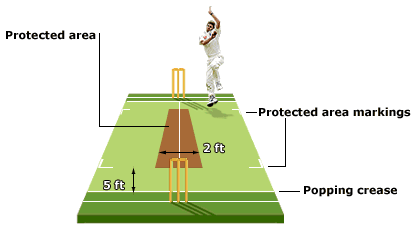
The word pitch has loads of meanings: you can pitch an idea, pitch a ball at baseball; it can be the pitch you play on, as in football (soccer), or the cricket pitch which is the piece of ground between the two wickets at cricket, twenty two yards long and ten feet wide – the hallowed piece of real estate that no one will walk upon.
People jump over it in case their foot leaves a mark or moves a piece of the sacred sod.
A pitch at baseball is what they call it when the 'pitcher' throws the ball at the batter, trying to get the ball past him, and into the catcher's hands – or to be more precise – his glove. The glove being worn on one hand – the none throwing hand.

Here is the picture of a pitcher:


not not that one – this one:


in all truth does this look more dynamic?


or this?


or even these 2 images.

Those last two are of Frank (Typhoon) Tyson a bowler – at cricket. 

And this is what it looks like at the other end:


At cricket you have to bowl the ball and keep your bowling arm straight or it will be a foul as you are not allowed to throw the ball which you are at baseball.

You will notice that the pitcher – no not the jug – lifts a knee just before letting the ball go.

Now why is this?

I think it's when you lift the knee you have passed the point of no return and you cannot throw the ball at one of the bases if you see a batter out of his ground which is what you can do before lifting the leg.

It's the same as running someone out at cricket – in cricket two bases, in baseball three bases and the batter's box as in the expression think (or whatever) out of the box.

Yes there are plenty of sayings from baseball but probably more from cricket – a straight bat, a safe pair of hands, a sticky wicket, it's not cricket and many more.

The glove is worn on the one hand, at baseball, so the fielder can throw the ball with the other; however, at cricket, they don't wear a glove at all even though the ball is heavier (between five and a half to five and three quarter ounces as opposed to the baseball which is five and a quarter ounces) apart from the wicket keeper which is the cricket equivalent of baseball's catcher. He wears a pair of gloves.


The difference in weight between the two balls means that the cricket ball can be thrown further than the baseball which makes the long fielding at cricket better than long fielding at baseball but baseball's close fielding is far superior; there is nothing so spectacular as the double (or even triple) play.

The object of both games is to score more runs than the other team; in cricket you can have a drawn game – that is when the time allowed for play runs out before the last batting team are all out – or a tie; that is when both teams score the same amount of runs. 

If this happens in baseball they play till one of the teams has more runs than the other when they have both batted for the same amount of innings; this can sometimes mean playing after midnight.

As a general rule, batsmen at cricket think they can play baseball – but they can't. In baseball when you hit across the ball and you have to run when you hit it.

As a general rule, batters at baseball think they can play cricket – but they can't. In cricket you get behind the ball and hit it with a straight bat but you don't have to run; you can play defensive – unheard of in baseball.

Two great games, though, and I am privileged to know both of them so I know what a 'curve ball' and a 'googly' is.

By the way in cricket it's an innings and in baseball it's an inning.

A run at cricket is when you run to the other end of the pitch (you know what pitch means) and the batsman (batter in baseball) at the other end reaches the wicket at the batsman's end who has just hit the ball.

A run at baseball is when the batter (batsman in cricket) has run all the way around the triangle.

Here's the triangle:

 And here's the cricket pitch:

The bowlers at cricket bowl fast or slow. The fast bowlers 'swing' the ball and when it bounces it can go anywhere and when they bowl slow they 'spin' the ball and that can go anywhere too.

Give yourself a treat and look at one of the greatest bowlers ever, the Australian Shane Warne bowling the ball of the century – see how good it is on the replay in this clip which is about one minute long:


I hope all this is clear?

Oh! Not to worry – I hope you enjoyed the pictures. Here is a simple explanation of cricket:

The aim of cricket is simple - score more than the opposition.

Two teams, both with 11 players, take it in turns to bat and bowl.
When one team is batting, they try and score as many runs as they can by hitting the ball around an oval field.
The other team must get them out by bowling the ball overarm at the stumps, which are at either end of a 22-yard area called a wicket.

A batsman protects his stumps A batsman protects his stumps
The bowling team can get the batsmen out by hitting the stumps or catching the ball. Other ways of getting out
Once the batting team is all out, the teams swap over and they then become the bowling side.
Each time a team bats it is known as their innings. Teams can have one or two innings depending on how long there is to play.
The Ashes Test matches are over five days so England and Australia have two innings each to score as many runs as they can.
Whoever scores the most runs wins. But a cricket match can be drawn too.
That happens when the team bowling last fails to get all the batsmen out..


Here for baseball:

A baseball game is played by two teams who alternate between offence and defence. There are nine players on each side. The goal is to score more runs than the opponent, which is achieved by one circuit of four bases that are placed on the diamond.

When it boils down they are the same game but that's the way the Americans play it; they misread the memo.

Here are the heroes; two in baseball and the other at cricket; these men will never be replaced:
Ted Williams of the Red Sox and Joe DiMaggio of the Yankees.

Ian Botham - a hero for all time (a sporting hero, that is).