Monday, April 23, 2012

Cry Gawd for Harry, Snooker and Saint George.

Snooker player using a 'rest.'

Today is Saint George's Day and Saint George is the patron saint of England.

In countries like Ireland, where their patron saint is Saint Patrick, their day is a public holiday - in fact till the 1970s the pubs were closed on Saint Patrick's day.

Saint Patrick's Day is also a public holiday in Newfoundland, Labrador and Montserrat – bet you didn't know that did you?

Saint Andrew is the patron saint of Scotland and Saint Andrew's day is also a public holiday there.

Saint Andrew, by the way, is also the patron saint of Greece, Romania, Russia and Ukraine and in Germany they celebrate Saint Andrew's Night - Andreasnacht – in Poland they celebrate Saint Andrew's Prayer.

All that celebrating so you would think they would observe their day here in England, Saint George's Day, and we 'd see celebrations, with the singing of Land of Hope and Glory, the wearing of the red white and blue but do we see it? To use a phrase from Billy Connolly – not a jot!

The only celebrations will be those toasting the 'bard;' his birthday was always thought to be St George's Day but it now seems it has been changed to April 26th - well that was the day he was baptised - and he died on St George's Day - Shakespeare I'm talking about!!

I have heard that there is a Saint George's Day Parade in Birmingham today and that there was one in Manchester yesterday – but it isn't a public holiday; everybody has gone to work and I haven't heard anything on the radio.

A few years ago the Welsh Assembly voted to make Saint David's Day a public holiday there but they had to apply to the Prime Minister's Office of Tony Blair and they turned it down.

The only big event in London was The London Marathon yesterday; it was marred by the death of one of the competitors, a 30 year old woman, who collapsed near the end of the race. It didn't have the same affect as the 2 horses that died in The Grand National last week (yes it was only last week).

Prince Harry was at the marathon and he seems a friendly kind of fella – very kind of blokey – unlike his brother; he doesn't have that awful South Kensington accent like his dad and Uncle Andrew or the half estuary accent like his Uncle Edward so I say good luck to him in his cage.

The other big thing that started yesterday was The World Snooker Championship; this will dominate the television for the next few weeks.

It's held in The Crucible Theatre, Sheffield and it is a big big business. The thing about snooker, as opposed to pool, is that it is a pondering game of enormous skill.

It was invented by army officers in India in the late 19th century; it was adapted from billiards, as pool was, and has now overtaken billiards in popularity, as pool has and is very popular the world over – except America.

The Americans called in snucker rhyming the 'U' sound with how you would say butcher.

The word snooker is also a state of play in the game itself: it's when a ball cannot be seen clearly by the cue ball and the only way to hit it is to cannon onto it via the cushion or by swerving the cue ball.

The difference between pool and snooker is that the table for snooker is 12 feet by 6 feet and the pool table is 7 feet by 3 and a half feet.

That's the big difference – it's a huge table so when you try to break the balls at snooker and you have to break them gently and not 'leave' anything on for your opponent; in pool you hit the ball as hard as you can as you are bound to get one in a pocket and then you are away.

But let us go back to the marathon and that girl that died. She died in Birdcage Walk a few minutes from the finish. She had been sponsored by friends and relatives and the object of her charity this time was the Samaritans.

She had climbed mountains and worked wonders for charity in the past and this morning the amount sponsored stood at around £5,000 – at the moment it is up around £81,000 and growing. This is what she was doing for charity; it seems such a moment when the giving to charity is all in the news because of the limits that are being put on the tax relief rich people are getting for their donations; unless they get tax relief they won't contribute.

Claire Squires wasn't claiming any tax relief for her donation; there she is below; spare a thought.

Claire Squires

The Marathon at Bird Cage Walk.

Monday, April 16, 2012

The Grand National

The Grand National
with eventual winner in yellow on the right

There are a few things in Britain which are unique to the place a few things which happen and when you live here you take them for granted.

There is the Oxford and Cambridge Boat Race (on the River Thames), The Derby, The Eurovision Song Contest and The Grand National.

The Eurovision Song Contest is a song contest between the European Countries – although Israel won it one year – the Boat Race is only peculiar to Britain but the Grand National is the greatest steeple chase in the world.

If you remember there was a movie about it called National Velvet which was one of the earlier films of Elizabeth Taylor.

The audience figures for the National go into many many millions as it is transmitted all over the world and as it is transmitted by the BBC it is the best uninterrupted coverage you can expect.

There are bookies on every corner in Britain – some would say too many – and it is the bookies greatest day of the year. The Derby would be the only other contender for this but usually nearly everybody will have a bet.

If they don't have a bet people will probably belong to a sweepstake at work where the name of a horse is drawn from a hat and if you are drawn the winner you take all.

You know which horse you have drawn before the race, of course, so you can follow it on the TV.

These days you can also follow it at the bookies on huge screens and there is quite an atmosphere in the betting shops.

Betting shops are usually miserable places as gamblers are not usually full of personalities. They keep themselves to themselves and some pretend they know something – something they got from the horses mouth. Others pretend they understand the form book but most pretend they win most of the time.

About 20 years ago there was a 10% gambling tax in Britain and you could either pay on your stake or on your take. If you won, obviously, it would be better to pay on your stake but most gamblers would pay on their take. I asked a few why they did this, as I always paid on my stake, and they said they lost most of the time.

But now there is no tax on gambling at all and no vigorish, like in America; the bookie has to work out by the amount of money that is being wagered on each horse to work out the odds and that is how they make their profit. If a favourite wins it is a bad day for the bookies. But they don't have many bad days – I mean have you ever seen a bookie or a farmer on a bike?

So on Grand National Day – and Derby Day – the miserable, scruffy, smelly, fag smoking gamblers cram in to the corners of the betting shops to make way for the flutterers, flitterers and first time gamblers.

Many years ago – in fact in 1961 when I was working on the motor bikes at the post office – there was a sweepstake at work and I drew a horse called Nicholas Silver – a grey.

I think it cost me a shilling which – for the youngsters out there – was one twelfth of a pound; in other words 5p or 5 pence.

I don't think a grey had ever won the National but in any case I went to the bookies, which were illegal in those days, and put a bet on. I put a whole pound which was about a sixth of my wages; it was a big bet as I was a fool.

The bookies was in a suburb of Birmingham called Selly Oak and I had to go up an alley to find the place.

As I've mentioned before, I had to wrap my pound note into a piece of paper and on the paper I wrote Nicholas Silver £1 win and handed it to a man standing in a door way.

The horse won at 33-1; so I won the sweep at work and also a lot of money from the bookies. On the piece of paper was my nome-de-plume and I had to quote this when I went to the bookies and he handed me £34; £33 for the odds and my £1 stake back.

This was a great deal of money to me back then and I wasn't really old enough to gamble but as it was an illegal bookies in any case what does it matter?

Official gambling in those days was only by credit; you had to have an account with the bookies and you paid your bill at the end of the month or whatever – and you were usually posh.

On Saturday the race was won by a grey again and this was the first time a grey horse has won since Nicholas Silver in 1961 and guess what the price was. 33-1.

And did I back it? No!

I watched the race on TV and kicked myself when Neptune Collonges came in first; there he is, above, in the yellow with the Irish jockey on his back; in fact most of the jockeys here are from Ireland.

It was one of the most exciting races I can remember and it took a photo finish to determine the winner.

I did fancy a horse called Sea Bass, which was ridden by a woman (from Ireland, of course) and it came in 3rd making her the highest placed female in Grand National History.

The big tragedy was that they had to put 2 horses down. It is the price we, or the horses, have to pay for such an exciting and unique event and we have to ask ourselves if it's worth it.

The decision to put the horses down is not made lightly. If a horse breaks a leg or a fetlock they have to be destroyed as there is no way you can 'contain' a horse so they kill the horse before they are in any real pain - and it's heartbreaking.

The people that usually complain about this don't usually have anything to do with horses and the people that put them down are usually the people who look after them like members of the family every day of the year.

Friday, April 13, 2012

William Shakespeare - did he or didn't he?

Bill the Shake.

Let's go along with this post and see where it goes . . . .

As regulars readers will know, I am not an expert on anything, so to take on the argument as to whether William Shakespeare actually wrote the plays he is credited with writing, is a tall order for me but when has that put me off?

I have appeared in a few Shakespeare plays and been paid for it as well as doing one when I was at drama school. I must say that I liked it very much. I have a problem watching Shakespeare sometimes with some of the over playing and lack of realism but that's just me.

I remember Jonathan Miller in Beyond the Fringe speaking lines like an Olivier influenced Shakespearean actor which showed up just how ridiculous some of the Shakespearean acting really was; and still is I'm sorry to say.

I remember years ago, Enoch Powell pontificating about William Shakespeare and saying that Shakespeare couldn't have written all the plays – in fact he said he had written none of them and that it was some aristocrat writing them in secret. He said how could he have known all the workings of the court to be able to write in such detail about it?

Like everything else Enoch Powell said, I disagree with him. He was a very clever fella but like a lot of clever people who are nearing genius their brain only has so much it can take in. This is why the absent minded professor or genius mathematician can't do mundane things such as boil eggs.

There has always been a school of thought that agrees with Powell but I have to ask why, after 400 years, would they bother?

Their argument is that Shakespeare wouldn't know the workings of the court or that he wasn't educated enough. Wasn't educated enough????

He went to Stratford Grammar School!! Isn't that enough.

You see because he didn't go to university they don't like the idea that he could write so many plays.

For the record he wrote 38 plays.

Alan Ayckbourn, the modern equivalent of Shakespeare, has written 73 full length plays all professionally produced – and he didn't go to university either.

He came from the theatre where plays are produced, where you learn what is acceptable and what isn't – and if you are a genius, which is what Shakespeare was, it is easy peasy.

One of Shakespeare's contemporaries was Ben Johnson and, even though he went to a posh school, he didn't go to university either. In fact after Westminster School he was a brick layer.

But why do people always question genius? It seems that every now and then they change their minds as to who wrote Shakespeare's plays apart from the great man; it also seems as if they would accept anybody apart from Shakespeare himself!

At one time it was supposed to be Francis Bacon but that went out of fashion then Christopher Marlowe was supposedly the author of the bard's work; he was murdered mysteriously so the theory was that he didn't die at all but that he pretended to be dead – like Elvis, Martin Bormann and Jim Morrison – and Shakespeare was 'his front' and lately it is supposed to be Edwards de Vere, 17th Earl of Oxford.

The theory with de Vere is that he had access to the court, he knew the goings on there and he must have written the 37 plays – all by himself.

Forget the fact that he died in 1604, 12 years before Shakespeare and 9 years before Shakespeare stopped writing.

Why did he stop writing they say. What does anybody stop doing anything?

People are judging Shakespeare by modern standards when writers retire and write their memoirs – did they do that then?

William Shakespeare died a few days short of his 52nd birthday; as we all get to find out that when you reach your mid forties something happens to the eyes; the rods and cones start to go haywire and you need glasses so maybe he couldn't see too good so for the last 3 years of his life he didn't write.

When Bob Dylan came on to the scene in the 60s people questioned whether he wrote all he was purported to have written – the same with The Beatles.

Anyway it is Shakespeare's birthday in a couple of weeks; he died on Saint George's Day – the patron saint of England – and in the next week there will be a lot of coverage on the BBC about Shakespeare; make a change from all the programmes on Charles Dickens and The Titanic!!

Sunday, April 8, 2012

Easter Uprising, 1st World War and my Grandad,

The Proclamation to the people of Ireland.

During the first world war there was an insurrection in Dublin and Pádraig (Patrick) Pearse, one of the leaders, declared independence for Ireland on the steps of the General Post Office. There is the proclamation above.

The British, who ruled Ireland at the time, attacked the insurgents with their 'long range guns' and ever since, the rebellion has been commemorated in Dublin each Easter.

The date was actually Easter Monday 23rd April 1916, it was organised by the Irish Republican Brotherhood and called The Easter Rising (in Irish Éirí Amach na Cásca).

Apart from knowing their catechism, the Irish know the names of all the heroes from that Easter week, and the names of the fifteen men who were executed by firing squad very soon afterwards.

Pearse was one of the first to be executed on May 3rd 1916; 9 days after the start of the insurrection.

One of those shot was the poet Joseph Mary Plunket who was suffering from consumption, at the time, and was married in the prison chapel just before his execution. He didn't write any poems, as far as I'm aware, about the insurrection (maybe he didn't have time) but some of his poems have a feeling of death about them.

His father was a Papal Count which is why his Christian names are of a saint; one male and one female as is the custom for Papal Counts.

W. B. Yeats wrote the poem 16 Dead Men which dealt with the executions (the 16th man was Sir Roger Casement who smuggled arms into Ireland) and his masterpiece of a poem Easter, 1916.

I asked my mother one day what grandad did in the uprising and she said “Ah – he was away getting gassed. Fighting for the British.”

She said it as if the sole purpose for going to France was to be gassed. But that's what happened. I asked my grandad what he knew about the Easter Uprising and he said very little.

He said the officer called him to one side and told him that there was a bit of trouble in 'your country.'

Thousands of Irish men were away fighting with the British whilst their comrades were at home fighting against them. It is the dichotomy the Irish have found themselves in over and over again - for example I believe they were on both sides during the American Civil War.

The 'bit of trouble in your country' was followed by the civil war and when independence was finally won, a movement of Unionists wanted the north to be partitioned away from the south and stay colonised by Britain. It is generally called Ulster but Ulster is made up of nine counties and there are only six in the so called Northern Ireland – a phrase my mother never used, by the way; she called it The North of Ireland.

If the whole of Ulster was to stay British it might have meant a majority of Catholics so they dropped Cavan, Donegal and Monaghan and left them in the Republic: talk about Gerrymandering. So the north were left with one Catholic county – Derry.

There is a pub in the San Fernando Valley called the 32 Counties - that's how many counties there are in the whole of Ireland so you know where their sympathies lie.

If you are wondering how this all started, and how there were, or are, so many protestants in the north, you have to go right back to the time of King James I, who sent a contingent of Scottish protestants to the north of Ireland. This was called The Jacobean Plantation of Ulster and a significant amount of land was set aside for Scottish courtiers and servants.

I don't know how many were sent over but it was about the same number who went on The Mayflower to America a short time later. I think the population of America speaks for itself but Catholicism still dominates most of Ireland.

However, The Jacobean Plantation of Ulster is recognised as the biggest ever real estate rip off.

But back to 1916; back to my grandad fighting with the British in the trenches; an Irishman aged about 20 when he went off in 1916. He was a married man with at least 2 children – my mother born in 1914 and her brother Tom – and was finding it hard to manage so he joined up.

I didn't ask him much about it, as I wasn't that interested in that war back then, but I pressed further about the atmosphere he found in Dublin upon his return from the Great War. He said he didn't get on well with his brother who had fought on the other side in Dublin.

He would go to the pub with his two brothers and the three of them were from different organisations; one was in the IRA the other in the IRB and my grandad was an ex (gassed) British soldier as far as they were concerned; it didn't stop them drinking with each other though.

My grandad would tell me of the days before he went away and he would say that the owl-ones (women) would stand on the street with their long frocks and pee in to the drains; you knew when this was happening, he said, as you could see them opening their legs slightly and standing for a few minutes – very handy for them too, now I think.

Here we are 96 years after the Amach na Cásca; Ireland, Southern Ireland, the Irish Republic, is ruled from Dublin but the country is still partitioned. The people up there call themselves Irish but they are still under the jurisdiction of London.


Wednesday, April 4, 2012

The Irony of Thatcher, Reagan and Easter.


It's a funny old thing isn't it; irony. Pronounced like that, by the way with the 'r' used; I heard so many mispronunciations when I was in America such as using the first two syllables like you would say iron – the thing that comes with the ironing board.

Some people say that the Americans don't know what irony is but the ones I knew did and in fact I'm not sure if I know for sure as the dictionary explanation says the use of words to convey a meaning that is the opposite of its literal meaning.

I mean that's sarcasm isn't it?I mean isn't it?

Irony to me is when someone tries to do some bad deed to somebody and . . . . well let's invent a little plot.

Let's say that a man is so poor that he mugs someone on the street.

He waits around a corner and pretty soon a little man with a funny hat comes along so he jumps on him and beats him up; injuring him very badly. But when he goes through the man's wallet he finds that there is nothing of any value in there; just some papers and cards. In a rage he tears the papers and throws the wallet into the river.

So he has beaten the man up for nothing.

But when he gets home, feeling miserable and a failure, he finds his wife jumping for joy for she has found that her late father's collection of baseball cards could be worth a lot of money; he has always known this but it's always been one card short.

She tells him a man with a funny hat is coming around with the missing card and they will all be rich.

That to me is ironic – the meaning in the dictionary is wrong.

Those kinds of things happen in real life and the story of Christ is the same; it's always been known as the greatest story ever told which is what it is and which is why a lot of people believe it and other stories have been written based upon it.

A great movie called Cool Hand Luke is a kind of Christ story complete with miracles, (the eggs), a crucifixion (he gets shot) and he rises from the dead in the shape of his photo being put back together with the shape of a cross across it and the prisoners worship his memory.

In real life President Ronald Reagan emptied the mad houses of America and, I am told, stopped funding research in to Alzheimer's Disease – he ended up with the disease himself.

Margaret Thatcher did the same in Britain and she has ended up with dementia.

And the Christ story; well his father, the father he had on earth, Joseph was a carpenter; he made all kinds of things and Jesus's brothers - yes he was supposed to have had brothers – ran the family business.

One of the things they made were crosses.

I think those stories are ironic?

Happy Easter and Passover.

Saturday, March 31, 2012

Stupid Government in Britain.

Petrol Pump Chaos in Britain Yesterday.

I have experienced lots of things in Britain; lots of crazy things that you wouldn't think a government capable of; it's great that it's not a banana republic or has a dictator in charge but that is no excuse for stupidity.

I lived through the Thatcher years when they abolished rates on property and introduced the Community Charge, the so called Poll Tax, the dismantling of the railway system in to a group of separate businesses that own various part of the rail network, like Virgin (try and get a train easily in the UK now), and saw the privatisation of many nationalised companies, but nothing can be prepared to what is going on here at the moment.

For people who do not live here there is a tax called Valued Added Tax – VAT or just vat – which is a kind of sales tax which is common in America. From now on I'm going to call it tax for the purposes of what I am talking about here.

Last week the Chancellor of the Exchequer delivered his budget to the House of Commons; this is the government's plan of fiscal action for the next 12 months.

This is where the government raises and decreases taxes and traditionally it's where they raise the price of booze, cigarettes, petrol and road tax. Road tax is the same as the tags you have to put on your car in America.

The budget was a bad budget for seniors and a good one for top earners; they have increased the tax for some pensioners who work and reduced the tax for the so called top earners. Top earners pay 50% of their income on the slice of their income over 150 or 250 grand; the Chancellor lowered that to 45% and paid for it with the pensioners tax increase.

That's by the by.

The VAT – the sales tax – is also applied to hot food and if you buy fish and chips you have to pay tax on the food – because it's hot.

The Chancellor has extended the tax to pasties, and other hot food sold over the counter, when they're hot so when you go to a deli and buy a hot pastie you have to pay the tax. If the pastie goes cold, whilst it's behind the counter waiting to be sold, no tax is applicable – I don't have to comment on that it's stupid; you can see that.

Then last week a cabinet minister went on TV and suggested that people stock up with petrol in case the tanker drivers go on strike. He said as well as filling your fuel tanks you should fill a spare can too.

This has resulted in all the filling stations in the country running out of fuel; lines of cars are queuing in the streets and causing traffic jams; police have had to close some of them because of the disruption to traffic.

It was on the news that the army is being trained to deliver the tankers to the petrol stations in case of an emergency because they don't want to see essential services such as hospitals being affected.

And guess what!!

There is no strike planned; the union for the tanker drivers are talking to the managements about the health and safety of actually delivering petrol – they are in talks; nothing more.

I hope we don't go to war with this lot running the country if those are the tactics they would use – they didn't think that a statement such as 'fill you cars just in case' would panic the country.

I rest my case.

Tuesday, March 27, 2012

American/British TV writing.

Fawlty Towers title card.

There is a big difference in attitudes between America and Britain; it is said that when you come up with an idea in Britain and talk to people about it they try and talk you out of it; if you want to do a comedy about crooks, for example, they'll say 'what about Bonnie and Clyde?' whereas the attitude in America is that when you come up with an idea they try and find a way of doing it. They will say about the comedy crooks idea 'a new take on Bonnie and Clyde; I like it.'

It's not a bed of roses over there where everything gets made as many a writer has found out; over there you have to learn to pitch an idea to the studios and if you're no good at pitching your script doesn't get looked at.

If your pitch is good and the script is good it still doesn't mean anything till a studio takes it on. There is such a thing over there called the black list. Now the black list in this case is not a bad thing; the black list is a list of the best scripts that haven't been bought by somebody – somebody important that is who are going to actually make the film.

There is also a big difference in the way a TV series is written; in Britain one person, or team, writes all the episodes of a TV series. Julian Fellowes wrote all the episodes of Downton Abbey and his latest hit Titanic; Dennis Potter wrote all the episodes of The Singing Detective; John Cleese wrote every episode of Fawlty Towers with his then wife Connie Booth.

On The Sopranos, in America, they had 12 writers, on Lost they had 23 writers (no wonder the plot went haywire) and on Cheers they had 36.

Sometimes the American series run in to hundreds of episodes so maybe a team of writers is understandable but some of the series in Britain, for example Till Death Us Do Part went in to 53 episodes and all of them written by Johnny Speight; it's interesting that when Till Death Us Do Part was remade in America under the title All In the Family they had 50 – one of them Johnnie Speight.

However the Americans make their series for years and Till Death Us Do Part is a good example of the difference in how long series run in the 2 countries. If the ratings drop in America the series gets dropped; not in the UK.

So what's the better way? The Americans will like their way and the British will like theirs.

However when it came to the greatest situation comedy ever the prize would go to Fawlty Towers even though they only made 12 episodes. 12 classic episodes and the writing team of Cleese and Booth said they couldn't write any more.

Before the days of popular videos pirate video tapes of Fawlty Towers were being sold for hundreds of pounds.

There is a series on television at the moment on both sides of the Atlantic called Homeland (12 writers) and I believe it's wonderful. It's everything I would want to see in a series as I have always been interested in the subject matter.

One of my favourite films is The Manchurian Candidate; I can't remember how many times I have seen it but the last time was in Los Angeles with the guy who directed it, John Frankenheimer, and one of the stars, Angela Lansbury.

That's what Homeland is about but the reason I won't watch it is because I really liked Lost when it first came on but because it was so successful they made hundreds of episodes and lost the plot; by the time it finished we were all bored with it and disappointed by the outcome.

That is why The Singing Detective (the TV series not the movie) was better than The Sopranos and Fawlty Towers was better than Cheers – in my opinion anyway.

There's a very interesting page about Fawlty Towers on Wikipedia which gives a few insights into the writing, the submission (the first episode was rejected by the BBC) and the difference between what would would have happened if the Americans tried to make it – here it is

http://en.wikipedia.org/wiki/Fawlty_towers you may have to copy and paste.


Thursday, March 22, 2012

Acting and Writing.

What is the creative difference between acting and writing apart from the obvious mechanics?

Why would I ask this question, first of all? Because I heard someone discussing it on the tube but I won't bore you with what they said because that's not my opinion – I'll bore you with what I think instead.

There is not a lot of difference at all – actors and writers have their own way of creating characters. Some sit in cafés or pubs and study people and some even go to the zoo.

I was playing a psychopathic murderer in a play once – Night Must Fall by Emlyn Williams – and there was a scene where the stage was bare apart from an old woman sitting in her wheel chair. It was dark and quiet and as she sat there the wind howled from outside and it was very scary then suddenly I poked my head through the curtain and the audience gasped and screamed.

The woman looked at me and was relieved as she knew me – Danny! Danny! she cried, then I came in and talked to her for a while.

As I was talking to her the audience could tell that I was going to kill her, chop her head off and put it in a hat box – at least that's what they thought and by the time the scene closed they knew that's what I was going to do.

There was something about the dialogue that the writer had written which needed something from the actor; I was saying one thing but meaning something else; I couldn't just stand there with my hands in my pockets or try to speak evil or look menacing. People don't pull faces and show their inner emotions if they're trying to trick somebody so what should I do – in my case I usually ask what would I do in that situation?

Then someone – not the director – gave me a note. He said I needed to stalk the woman like a lion or a tiger; and he was right. That's what I meant about going to the zoo!

So I paced around the stage as I talked to her and it worked. I was as charming as I had been in the previous scenes with her but there was something about me which gave the message to the audience that I was up to no good.

Some actors would say, never mind the audience - worry about 'the work' – I know what they mean but we are doing it for the audience; who else?

In that case the writer had given me the bare bones and I had to put flesh onto them.

The lines – or the dialogue – should come last in a characterisation even though you learn them first; you learn them first to get them out of the way but these days with film acting you don't learn anything as you don't rehearse much.

Rehearsals are a learning process and this you do as you rehearse. Sometimes on a film I have only just about got the lines into my head before having to say them; so I deliver them as if that's my raison detre then go away; nothing learned.

Later I might think maybe I should have done them this way or that way and the day after that I had forgotten them altogether.

That's what you have to do as an actor but it's a shame as the chances of you seeing that performance many years down the line and cringing is quite a possibility.

Whereas the performance in a theatre, which disappears into oblivion, is rehearsed, practised and has the benefit of being performed many times to near perfection.

Some of the great film directors, such as Sydney Lumet, would have a period of rehearsals which is why their movies have great performances – I mean look at Dog Day Afternoon.

But back to writing and acting – they are the two things that everybody thinks they can do; they think they can do this because they can put words on a page – writing – and they can speak – acting!

But that's not all there is to it.

The best scripts, movies, books, plays or whatever are character driven; the alternative would be plot driven.

There are some great films, I'm sure, which are plot driven; I haven't seen the Star Wars films but I am told they are plot driven with lousy dialogue and poor development of character but I am also told they are great films.

Look at the film Avatar – no nothing to do with an Indian deity - which was a pioneering film which everybody thought was the answer to the future, a new way of making films, with 3D and all that; only the characters were one dimensional and the dialogue was terrible but then again – I didn't see it.

A film I did see was Tinker, Tailor, Soldier, Spy which I loved; I loved it because the acting was good, the characters were well drawn, the plot took a lot to figure out and I like to have to work things out for myself.

Of course a lot of people didn't like it, because they couldn't follow it, but people thought the same when the TV series was popular in 1979 with Alec Guinness playing Smiley; I wonder if they'll make the sequel Smiley's People?

So writing and directing are one and the same apart from the logistics of it – they both create characters and some of them even go to the zoo.

Here I am in Night Must Fall – many years ago:

as Danny in Night Must Fall.

Tuesday, March 20, 2012

Cats.

The smiling cat - El Grande.

We are, unashamedly, lovers of cats. We love their habits, their games and their funny little ways.

We know some people don't like them and prefer dogs as the dogs seem more dependent on them and the cat is independent but that's what we like about them.

Stroking a cat, as you watch television, is said to be good for your blood pressure but the love and pleasure you get from them can make you very happy – and when you lose them they break your heart – just as when you lose a dog.

Of course, some people don't like cats or dogs or any animals even though they give us more than we ever give them – there's something the matter with you if you don't like animals at all and people who are cruel to animals certainly have something wrong with them.

We have had dogs too and dogs at the same time as the cats; one dog we had would let one of the cats sleep on his head – not whilst he was lying down but as he sat up; I can still see him sitting there frightened to move in case the cat fell off.

But I have had cats all my life; when a child I had a kitten called Elvis who suddenly didn't come back one day; he was a black cat with a white breast and I was sure that somebody had taken him till my mother told me that he had been killed on the main road.

That is the problem when you let your cat out – they don't know the highway code and they run in front of cars and lorries.

When we lived in the country we had a dog, and at least 3 cats that were run over, but then went through a good patch when we had 5 at the same time; their names were Graymalkin, Biddy, Biggun, Lamb Chop (or Fluff) and Gizmo.

When we went to the vets they would say 'you're the family with the funny cat's names' – I got the name Graymalkin from the cat that's mentioned in Macbeth!!!

But as I said when you lose one they break your heart.

Our cat – El Grande – died yesterday; he seemed to be as fit as a fiddle 6 weeks ago, jumping over the furniture and the bannisters but suddenly he started falling over, it got so bad that he couldn't walk or even stand; all in 6 weeks.

The vet said it was probably a brain tumour so he was put to sleep.

He came with us from America and only managed to spend 3 months in his new house so now when we come in there is no cat to say hello as we walk through the door.

There he is above - smiling.

Monday, March 12, 2012

Saint Patrick's Day.

Saint Patrick's Window.

In the 18th century, about 1770, there was a fella called John O'Leary in County Cork, Ireland, who had something to do with my existence.

He was married to Kathleen and one day he was caught stealing sheep and was transported to Australia; poor Kathleen had to stay behind and never saw John again.

However, she remarried and I will presume she had some kind of divorce first; although that seems hardly likely.

Divorce wasn't easy in Ireland in the 20th Century don't mind the 18th as it took an act of parliament for women to divorce their husbands in those days as Ireland was still governed by the British Crown.

Kathleen became Kathleen O'Sullivan and eventually some way down the line of Sullivans I arrived.

Now was John O'Leary – or was it O'Laoghaire? - hungry when he stole the sheep or was he just a rustler? Was he out drinking the night he stole into the field and made it away with the animal and did he crouch at the side of the field thinking “Will I take it? Will I? Will I?”

Or did he draw up in his horse and cart with a few friends and load them up on to the back of the cart and distribute them to the poor and was then shopped by a customer?

This was before the famine – but he might have been hungry!!

Will I take it and will I get caught and if I get caught will I be transported which will give life to a load of Sullivans? What's it to be?”

Whatever the reason or the explanation we will never know; the fact is I'm here; I arrived and the actual act of putting his two hands around that animal was the cause of my existence. So I have been giving sheep a sheepish look ever since I found out about this fact.

But poor old John; nobody knows what really happened to him – they might have at one time but that is all forgotten; let's hope he had a wonderful life in Botany Bay.

The Irish Rebellion came about 25 years later and the famine came about 50 years after that so he was just as well living in the sunshine for the rest of his life.

The Rebellion, the famine, and all the other trials and tribulations, made the Irish a strong people and the experience of this produced an extraordinary amount of writers from such a tiny isle.

7 Million people were pared down to 4 million in no time at all and Irish writers, like the Jews, made fun of their rulers and colonists and commented further about their plight; maybe this was the reason 4 Irish writers – and I say again – from such a small country, won the Nobel Prize for Literature; and that's not counting James Joyce, Brendan Behan and a host of others.

So this week celebrate Saint Patrick's Day and think how lucky you are that the Irish are here to amuse, enlighten and maybe even educate you.

I will be doing my one man Irish show at a small private theatre here in Eastcote, Middlesex, so for the rest of this week I will be practicing my guitar to get my fingers nimble for the task – so wish me luck.

Monday, March 5, 2012

Seats for the Oscars and Goodbye to a Day Dream Believer.


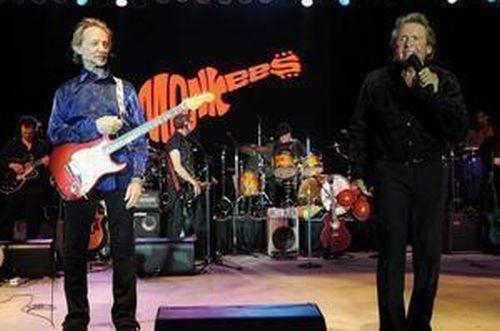
Peter Tork and Davy Jones.
It's been a week since the Oscars and in that week we've lost Davy Jones who died of a heart attack; there were a few initial stories as to where he died: one version said he died in his sleep another said he was found in his car complaining of chest pains and experiencing breathing difficulties and after being rushed to hospital in Florida he was pronounced dead on arrival and the latest is that he died in his horse riding stable with his horses; the bottom line is he died.
Not a lot of people know this (to paraphrase Michael Caine) but he was the original Monkee – he was cast first and the others had to audition.
Peter Tork said he kind of resented him when he came in to the auditions and swanned straight in to see the producers; then when they had to go in for their auditions they were 'paired' with him.
Of course they got on well later.
And how did they know about him? The producers, I mean.
On the night The Beatles were on the Ed Sullivan Show, when street crime and burglaries stopped for an hour in New York, Davy Jones was in the show with them.
He was playing The Artful Dodger on Broadway in Oliver and sang a song, with Georgia Brown, from the show and the producers saw him.
So he was already contracted to the film company who produced The Monkees but had to meet the producers first.
Before that he was in Coronation Street playing Ena Sharples' grandson and various other British TV appearances and then he trained as a jockey before going into The West End in Oliver and then to Broadway.
I don't think any of the Monkees made money from the re-runs of the show, so when he finished with it he started a street market in New York and then, after losing a lot of money, resumed his career as a jockey.
In tribute to Jones, Lingfield Park Race Track announced that the first two races on the card for 3 March 2012 would be renamed the Hey Hey We're The Monkees Handicap and the In Memory of Davy Jones Selling Stakes with successful horses in those races accompanied into the Winners' Enclosure by some of The Monkees' biggest hits. Plans were also announced to erect a plaque to commemorate Jones next to a Monkee Puzzle tree on the course.
Of course he died in a leap year on February 29th – a date they will only remember every four years which coincides each year with the Olympic Games and the American Presidential Election.
Changing the subject a lot of people have asked me, as I lived around the corner from The Kodak Theatre, if I ever went to the Academy Awards show or even waited outside to see the stars coming and going; well not necessarily going just coming.
Well no, I never went; it is possible to get an invitation to the actual show if you are a prominent business owner but you'll end up in the gods. My landlady went the first year I was there and it might have been possible to go in those days and stand in the crowd outside.
The Oscars were held at a different place each year; one year it would be the Shrine Auditorium and the next it would be in The Dorothy Chandler Pavilion in The Music Center. Since they have been held at The Kodak Theatre in Hollywood all has changed.
As I mentioned before, you can't even walk along Hollywood Blvd without going through security checks, so who are those people outside that greet the stars?
Well you could be one of those if you wanted to be – all you have to do is write to the Academy, tell them you would like to be in the Bleachers Seats– which is what those seats are called – and they will choose so many out of the hat, so to speak, and then you can go.
They will, of course, put you through a very strict security check and, if you are successful, you can go and they will wine and dine you for the day – they even have wheel chair access for those needing it.
They have elevators to get you to your seats, food service and when the show starts they take you across to El Capitan Theatre, opposite, and you see the show on the big screen; there you get hot dogs as opposed to the Wolfgang Puck menu the stars will eat.
So give it a go for next year but don't ask me for any addresses.

Saturday, February 25, 2012

Oscar odds and the hanging British Light Switch.

British bathroom hanging light switch.

Being relatively new to being back here, the mind wanders when I look around and think about what my American friends would think if they saw certain things here.

I know it's like that when you get to America; the one thing I have always known is that when you use the light switch in the USA you put it into the 'up' position to put the light on whereas over here you put it down.

Everything else is the other way around too, as you will know, like driving on the other side of the road and, which I found a surprise, the back brake on my bicycle over there was on the right handle bar.

Well I was in the bathroom the other day and I wondered what they would think of the light switch here in all bathrooms.

For the Americans who have never been to the UK, there are no electrical devices in bathrooms here, no electric sockets just a piece of string, with a weight, hanging from the ceiling - as above. This is everywhere and this is in case we would try to put the lights on or off with wet hands and be electrocuted.

By the way electrocution is death – in the USA they use electrocution when they mean a shock.

So it might be funny to them – it should be funny to us but we have got used to it. I mean we don't have the string in any other parts of the house such as the kitchen when our hands are nearly always wet. We use the electric mixer with wet hands so why don't they have hanging light switches in there - just a thought.

Now this is Academy Award weekend and I will really miss the sense of occasion by not being in Hollywood for the first time in 17 years – or 17 award shows apart from one one when I was filming over here; that was the year Helen Mirren won for The Queen and as she lived just around the corner from us we might have seen the limo.

The betting odds for the OSCARS are interesting. The best actor is a toss up between George Clooney for the Descendants and Jean Dujardin for The Artist; Dujardin is odds on at 4/6 and Clooney is slightly better than evens at 11/10.

Meryl Streep was the favourite at one time but the favourite now is Viola Davis from The Help at 8/13.

The best supporting actor should go to Christopher Plummer; at the moment he is not worth a bet as his odds are 1/33 – for those who know nothing about betting, you have to put £33 to win £1; which is hardly worth it unless you are putting £33,000 on and in that case the bookie would give you £34,000 back for your £33,000 staked. It's an easy grand but you would have to put it on in the UK where there is no gambling tax and there is a chance that he might not win – I liked Kenneth Branagh in My Week With Marilyn.

For Best adapted screenplay The Descendants is strong favourite at 1/5, but Tinker Tailor Soldier Spy is a good outside bet at 20/1.

If betting on the winners doesn't take your fancy, there are plenty of other ways to spread around you money at this year's event.

William Hill are offering 6/1 on Meryl Streep losing her shoe again if she wins Best Actress (she first did it at the BAFTAs).

There's a 3/1 chance one of the winners will swear during a speech, while you get 8/1 on a host to announce the wrong winner.

Based on the above here's what I say for the OSCARS; I have no special qualifications or knowledge and also I think it's too late to get a bet on here:

Best Actor – George Clooney. Best Actress - Viola Davis.

Best supporting actor - Christopher Plummer. Best adapted screenplay - The Descendants (Alexander Payne and Nat Faxon). Best Picture The Artist.

You can only make money on this if you have a yankee bet so drop Christopher Plummer and go for the rest – that is 6 doubles, 4 trebles and one accumulator. A £1 yankee, which is 11 bets, will cost £11.

You won't make a fortune but the accumulator on the above odds for the £1 bet would bring you will bring you about 3/1 – put Tinker, Tailor, Soldier, Spy in there at 20/1 instead of The Descendants and it's worth doing as that is a really clever brilliant screenplay and my favourite film of the year.

Tuesday, February 21, 2012

My teenage love story!

The Poni Tails
Well, when I was a young man never been kissed
I got to thinkin' it over how much I had missed
So I got me a girl and I kissed her and then, and then
Oh, lordy, well I kissed 'er again . . . . .
When I was about fifteen or so I fell in love; I fell in love with three girls in a place called Wythenshawe, which was in the south part of the city of Manchester.
I was staying there for two weeks at my aunt's house and quite near to the house was a block of flats – and of course in the flats there were plenty of young girls.
I would pass the flats most days as I was staying up there by myself. I worked for the post office and had to take my holidays when they told me so everybody else was at work or school at the time.
I was kicking my heels around the house and my mother suggested I go and stay with her sister, my Godmother, and her family; their children were little more than babies so they were no good for me to pal about with; one day we went on a picnic with a maiden aunt of theirs and I went along too.
It wasn't a picnic as such, she called it a ramble – I don't know if she was part of a ramblers club or anything but she might have been in her forties and wore sensible shoes, a tweed skirt and carried a stick.
It was pleasant and at one point my little cousin sat on my lap and the aunt said 'Oh, Christopher isn't used to having little girls sitting on his lap' and I said 'no, I'm used to big girls' and her face kind of dropped.
It was the first thing that came in to my head but I got to know the girls from the flats – well some of them – and they used to sit on my lap. There was a pair of sisters – one aged 14 and the other 15 – and another girl older who was about 17 or 18.
I dated each of them and they seemed to know about each other going out with me. We went to a fair ground, which was a bus ride away, and to the movies which was also a bus ride away. In fact everything was a bus ride away as Wythenshawe, in those days, was in the countryside.
I took the older girl to see The Duke Wore Jeans, in the centre of Manchester, which starred Tommy Steele and whilst we were sitting there a fight broke out – between 2 girls.
One was sitting in front of the other and something was said, then the one in front stood up and they were fighting and pulling each others hair over the seats . . they were kicked out.
Now when I said I fell in love I mean I fell in love with a different one each day; I was only 15 and what did I know about love?
We would 'make out' on the stairs of the building in which they lived, and the pop music of the time was the sound track to our activities. The 14 year old was really gorgeous but she was too young for me – don't forget I was 15 and she was 14; I wasn't a baby snatcher!!
The song by The Pony Tails, Born Too Late, would ring in my ears when I thought of her and the same song rang out when I was with the older one.
Born too late for you to notice me
To you, I'm just a kid that you won't date
Why was I born too late?
The other one, the 15 year old, was the one who wrote to me when I returned to Birmingham and once or twice the older one wrote but never the 14 year old.
It was nothing serious, of course, but my aunt found out about it and didn't want me going with people from the flats – maybe she thought they were leading me in to a life of vice and drugs!!
One day I was due to meet the girls but my aunt said it wasn't to be; they were taking me out somewhere in the car – I can't remember where but it wasn't for a ramble.
I had to go and tell the girls that I wouldn't be there that day and when we went out in the car the 3 girls, and some of their friends, came out and got close to the car and blew kisses and waived – my aunt was disgusted.
Eventually the time came for me to go back to Birmingham and we were all heartbroken; I remember the tears welling up inside of me as the train pulled out of Manchester, Piccadilly Railway Station. I was in bits as I loved my life up there for the two weeks and then it was back to Birmingham and back to work.
I did nothing but mope around for what seemed weeks and then one night I decided to run away to Manchester. I knew where it was – in the north of England – so I started out.
I walked in to the city centre then up through Aston, which is going north; I seemed to walk for hours, in fact I did, and pretty soon it was after midnight and I was in Sutton Coldfield, which is 8 miles from the centre of Birmingham.
Near Sutton Coldfield, a car pulled in and asked me the way to somewhere – I couldn't really tell them anything and they told me they were eventually going to Manchester; oh I was tempted, I can tell you, and when they drove off I realised I was on an impossible trip, so I turned around and walked back.
After a little while a policeman came up to me and asked what I was doing – I told him I was out for a walk.
He took me to Aston Police Station, sat me down and gave me a cup of tea; then they called the police station, close to where I lived, and a copper from there went and told my worried parents that I was safe – we didn't have a telephone in those days; who did?
My dad didn't have a car so he rode across to Aston on his bike; the Raleigh that I have written about before, the Raleigh that I inherited and the Raleigh that my brother was knocked off one day as he rode along Moseley Road, which was a main thoroughfare.
When he came to the police station my dad was all smiles for me and the cops and they asked him how he would get me home.
'On my crossbar' he said 'if there are no police about.' it was against the law to give lifts on crossbars but it was two-o-clock in the morning and the coppers laughed.
On the way home he said 'we won't tell your mother you were on your way to your aunts.'
I said 'I was on my way to see my girl friend.' He didn't understand.
Young love, first love Filled with true devotion 
Young love, our love We share with deep emotion

It took me a few days to recover as every part of my body 
really ached.
In 1984 I was on TV in a series called 'Eh Brian! It's a Whopper, a drama comedy series about some anglers, and I received a fan letter from the older girl. She told me her marriage wasn't going very well and said I looked really good for 50!!!! 50??
So I got me a girl and I kissed her and then, and then
Oh, lordy well I kissed 'er again
Because she had kisses sweeter than wine
She had, mmm mmm, kisses sweeter than wine.


Jimmy Rodgers

This seems to be a very popular post; I am flattered but if you want more information write to me at bobbydelderfield@hotmail.com
or
Look for me at the Internet Movie Data Base -
http://www.imdb.com/name/nm0838002/?ref_=nv_sr_1